What Is AEO? 7 Strategies To Rank in AI and Voice Search Results
4th July 2025 / in SEO / by Ruturaj Kohok
- Reading time: 10 mins 06 Sec
We understand how overwhelming it can feel when new acronyms keep popping up in digital marketing.
But AEO isn’t just another passing concept: it’s becoming absolutely essential for visibility in today’s search landscape.
So, what exactly is Answer Engine Optimisation?
It’s a strategy focused on getting your content to appear in AI-generated responses to user queries.
Now, some people think AEO marketing is completely separate from traditional SEO, but they actually share a significant overlap.
The difference is that AEO SEO specifically targets those coveted answer boxes and featured snippets that can significantly improve user engagement and drive organic traffic.
When you appear in these prime positions, you’re not just improving visibility; you’re establishing brand authority and credibility.
Also, technically, all the optimisation techniques for AEO are things you should already be doing for effective SEO.
Ready to adapt your strategy for the age of AI and voice search? Let’s check out the seven strategies that will help you stay ahead of the curve.
What is AEO, and why does it matter?
Answer Engine Optimisation (AEO) is the process of structuring your content to provide direct answers to user search queries.
Rather than simply attracting clicks through conventional SEO tactics, AEO SEO focuses on getting your content featured in AI-driven search results like featured snippets, voice assistant responses, and AI-generated summaries.
Source: Leads Leader
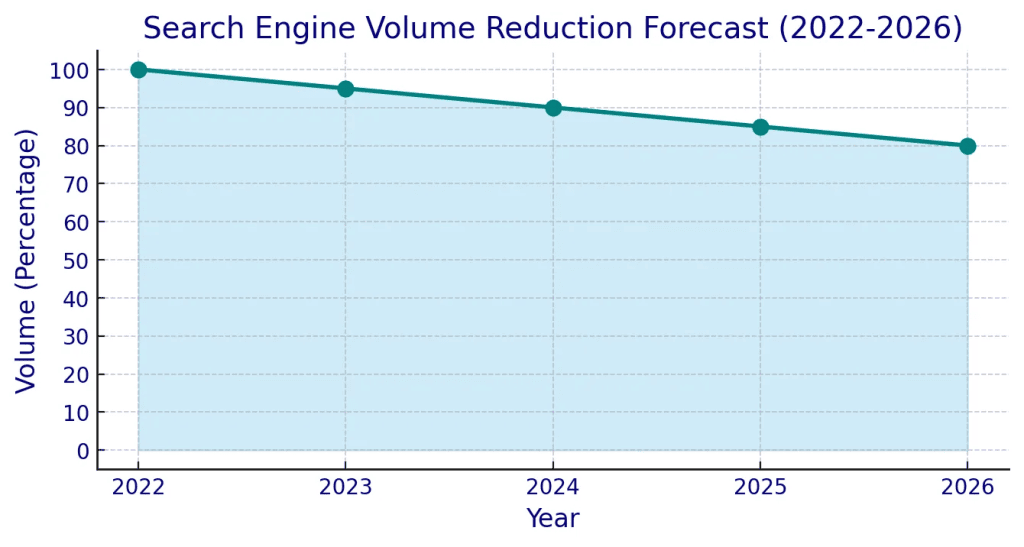
A study predicts that by 2026, traditional search volume could drop by 25%, and organic search traffic may decline by as much as 50% as users increasingly turn to AI-powered tools for answers.
How AEO fits into modern SEO?
Many marketers wonder if AEO replaces traditional SEO. The answer is no, they complement each other rather than competing.
Think of it this way: SEO drives traffic to your website, and AEO gets your content featured in AI-driven search results.
Together, they create a comprehensive strategy that maximises visibility across all search environments.
AEO in SEO is a fundamental shift in how information is discovered and consumed online.
Here’s how:
- Traditional SEO aims for broad keyword visibility across search engine results pages
- AEO narrows its focus to providing direct answers to user inquiries
Instead of targeting a range of keyword rankings, AEO marketing focuses on securing spots in quick-answer formats such as featured snippets and voice search results.
AEO naturally aligns with EEAT (Experience, Expertise, Authoritativeness, and Trustworthiness) because it prioritises clear, helpful, and credible content.
Only content created by knowledgeable sources gets picked as AI answers, which means investing in quality pays dividends in this new landscape.
The rise of AI and voice search:
Previously, SEO was built around keyword density, backlinks, and metadata. But the rise of voice search has made context and intent more important than raw keywords.
Voice searches and queries in AI tools like ChatGPT are much more conversational and question-driven compared to traditional searches in Google, Bing, and other search engines. This makes it important to optimise for voice searches.
Answer Engine Optimisation involves content that answers specific questions, using the same language that searchers are using, which can boost visibility for web pages featuring it.
Modern search engines now use advanced Natural Language Processing (NLP) models such as BERT and MUM to understand user queries better.
This impacts business visibility substantially.
AEO SEO helps your content appear in Google’s AI Overviews, featured snippets, voice search replies, and conversational tools like Perplexity, Gemini, and ChatGPT.
This expanded visibility builds brand credibility as users increasingly rely on these platforms for information, as being cited by AI as a reliable source enhances your brand’s reputation.
As Google’s Search Generative Experience (SGE) and similar AI-powered features become more prevalent, the focus will shift from simply ranking high in search results to being the most accurate, concise, and trusted source of information.
Businesses that adapt their content strategies now will gain a significant competitive advantage in the evolving digital landscape.
AEO vs. SEO: What's the difference?
While both aim to improve online visibility, they differ fundamentally in their approach and objectives.
Focus on direct answers vs. keyword rankings:
Traditional SEO focuses on ranking web pages for specific keywords, whereas AEO SEO prioritises positioning your content as the direct answer to user queries.
Users increasingly expect immediate, concise responses to their questions, particularly when using voice assistants or AI tools.
Consider these fundamental differences:
- SEO: Targets keyword rankings across multiple positions on search engine results pages
- AEO: Aims for the single “best answer” position in featured snippets, knowledge panels, and voice responses
While SEO content can capture traffic through related keywords and topics, AEO demands exact answers to specific questions.
Content in Answer Engine Optimisation must be substantially more focused on addressing user intent directly.
SEO typically measures keyword rankings, organic traffic, and click-through rates. Meanwhile, AEO tracks featured snippet acquisitions, voice search appearances, and AI citation rates.
SEO drives users to your website, where they may need to navigate to find information. AEO delivers answers directly within search results, potentially bypassing your website entirely.
Overlap in optimisation techniques:
Many optimisation techniques benefit both strategies simultaneously, making them complementary rather than competitive approaches.
We know that both require high-quality, authoritative content that satisfies user intent. Content that ranks well in traditional search results often provides the foundation for AEO SEO success.
Technical optimisation elements benefit both approaches as well:
- Schema markup: Helps search engines understand content context for both traditional rankings and direct answers
- Page speed: Improves user experience and ranking potential across all search environments
- Mobile optimisation: Essential for both SEO rankings and voice search results
E-E-A-T principles (Experience, Expertise, Authoritativeness, Trustworthiness) remain fundamental to both strategies.
Search engines and AI systems alike prioritise content from credible sources.
The ROI impact when implementing both strategies cohesively is substantial. Businesses that integrate AEO in SEO frameworks report an increase in overall organic traffic, higher conversion rates, and improvement in brand authority metrics.
Content optimised for both AEO and SEO tends to perform better over time because the precision required for AEO naturally improves the focus and quality of SEO content.
The process of identifying and answering specific user questions inevitably creates more valuable content for all search contexts.
While AEO and SEO differ in their primary focus, they function best as complementary strategies within a unified content approach that performs exceptionally well across all search environments.
7 Strategies to Rank in AI and Voice Search:
Success in the AI-driven search landscape is all about adapting your approach to meet what search engines AND users actually want.
We know it can feel like the rules keep changing, but implementing effective AEO SEO strategies can dramatically improve your visibility across both traditional and AI-powered search environments.
Let’s begin!
#1 Understand and target search intent:
Search intent forms the foundation of answer engine optimisation. Instead of just stuffing keywords everywhere, AEO demands understanding WHY users search in the first place.
Search engines like Google now prioritise content that directly addresses user needs over content that merely contains relevant keywords.
There are four main types of search intent you should target:
- Informational (“How to do AEO?”)
- Navigational (“AEO marketing guide”)
- Commercial (“Best AEO tools”)
- Transactional (“Buy AEO optimisation services“)
The content types and formats that already rank provide valuable insights into what search engines consider relevant.
Tools like Google’s “People Also Ask” boxes offer a goldmine of intent information, literally telling you what questions people have around your topic.
#2 Optimise for featured snippets:
Featured snippets appear at the top of search results and are prime real estate for AEO marketing.
These snippets get approximately 8% of all clicks, providing a significant boost to your organic click-through rate.
To optimise for featured snippets:
- Provide clear, concise answers (40-60 words) that Google can directly use
- Include the question as an H2 or H3 heading above your answer
- Structure content with proper formatting (tables for comparisons, numbered lists for processes)
- Target long-tail, question-based keywords which trigger most featured snippets
Source: Engine Scout
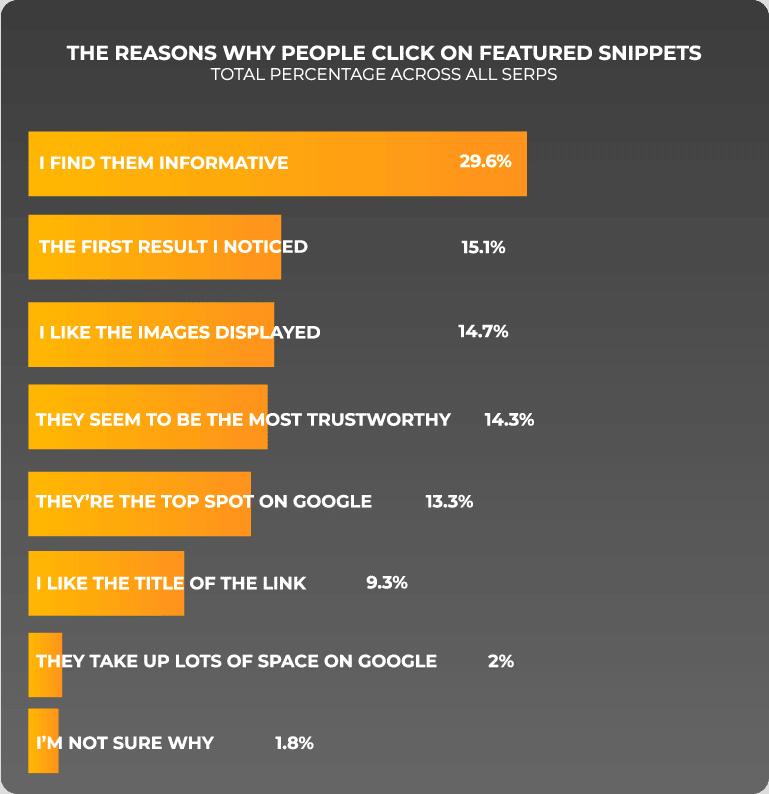
According to a study, 29.6% users found featured snippets informative, whereas 15.1% noticed it as the first result.
This alone makes it important to optimise for featured snippets for AEO in SEO.
#3 Use structured data for better indexing:
Structured data or schema markup is a code that helps search engines and AI platforms understand and categorise your content better.
This machine-readable code translates your content into a format that makes it easier for AI systems to extract key information.
The most effective schemas for AEO in SEO include:
- FAQPage schema for question-answer pairs
- HowTo schema for step-by-step guides
- Article schema to define main content elements
- Product schema for e-commerce sites
Google’s preferred implementation method is JSON-LD markup following schema.org standards. This approach integrates smoothly into your code without disrupting visible content while significantly increasing your chances of appearing in rich results.
#4 Write in a conversational tone for voice search:
Voice searches are inherently more conversational than typed queries. Users speak in complete sentences rather than keyword fragments when using voice assistants.
Instead of typing “best Italian restaurant NYC,” a voice searcher might ask, “What’s the best Italian restaurant near me open right now?”
Use question-based headings throughout your content and provide direct answers that voice assistants can easily extract.
This shift demands content that mirrors natural speech patterns, improving your AEO marketing efforts.
#5 Build a comprehensive FAQ section:
FAQ sections naturally align with how users phrase their queries to AI and voice assistants.
They provide direct answers to specific questions, making them perfect for AEO in SEO. These sections also build user confidence by demonstrating expertise and transparency.
When creating FAQ content, focus on:
- Framing questions as users would naturally speak or type them
- Providing short, accurate answers first (40-50 words), followed by more detailed explanations
- Implementing the FAQ schema markup to help search engines recognise your content as potential direct answers
- Including questions about services, processes, pricing, and common concerns
#6 Get listed in relevant business directories:
For local businesses, directory listings significantly impact AEO marketing performance, especially for voice searches with local intent.
Voice assistants often pull business information from these directories when answering location-based queries.
To maximise this opportunity:
- Create and manage a complete Google Business Profile
- Develop individual location pages for each business location
- Ensure consistency across all directory listings
- Post content regularly and encourage customer reviews
- Keep contact information visible and accessible
These steps help voice assistants and AI systems confidently recommend your business for relevant local queries.
#7 Keep content updated and accurate:
Content freshness serves as a crucial ranking factor for both traditional search and answer engine optimisation. Search engines prefer recently updated content, particularly for topics that change frequently.
Updating old content can deliver faster results with less work than creating new content from scratch.
This increases crawl frequency, improves visibility, and enhances your chances of being featured in AI responses.
Focus your updating efforts on:
- Adding new information or data
- Fixing outdated recommendations
- Improving clarity and readability
- Enhancing structured data implementation
- Expanding content to address additional questions
Check this out:
Source: Single Grain
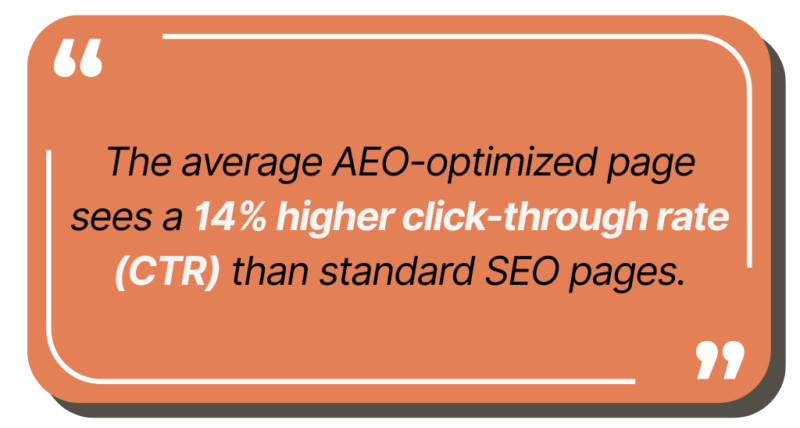
AEO-optimised content typically sees 14% higher click-through rates from featured snippets compared to standard search results, making all these AEO SEO strategies SUPER important to implement.
How to do AEO for your website?
The most effective approach to implementing AEO is to start with what’s already working and gradually optimise from there.
Let’s explore a practical, step-by-step process to implement answer engine optimisation on your existing website.
Start with existing high-performing pages:
If you’re wondering how to do AEO, the smartest way is by identifying and optimising content that already performs well.
This approach delivers faster results with significantly less effort than creating entirely new content.
Here’s how to identify your best candidates for optimisation:
- Check Google Analytics to find pages with high traffic but average engagement metrics
- Look for content that already ranks on page one for question-based queries
- Prioritise pages covering topics frequently appearing in “People Also Ask” boxes
- Focus on evergreen content that answers fundamental questions in your industry
Once you’ve identified these pages, restructure them to provide direct, concise answers within the first paragraph or shortly after the heading.
Aim for brevity (40-50 words) for potential paragraph snippets. This immediate answer approach dramatically increases your chances of being featured in AI-generated responses.
Use tools like Google Search Console and ChatGPT:
The right tools make the implementation of answer engine optimisation substantially more efficient. Google Search Console offers invaluable insights into how your content currently performs for question-based queries.
Start by analysing the ‘Performance’ report to identify questions already driving impressions or clicks to your site. This reveals your existing AEO marketing opportunities without requiring additional research.
Look specifically for queries beginning with who, what, where, when, why, and how: these typically indicate question-based searches.
Simply prompt ChatGPT with general topics related to your business, and you’ll find natural question patterns that might not appear in traditional keyword research.
Beyond these, specialised tools like AnswerThePublic and AlsoAsked help identify the specific questions your audience asks, providing a roadmap for your AEO content structure.
These insights enable you to create content that directly addresses real user queries rather than guessing what questions might be relevant.
Test different formats for better results:
Not all AEO content performs equally well; different question types call for different content formats. The best answer to “how to do AEO?” is experiment: with various structures to discover what works best for your specific topics and audience.
For “how-to” questions, numbered lists typically perform best.
For comparison questions involving “vs” or “best,” tables often generate superior results.
For definitional questions, concise paragraphs of 40-60 words have the highest snippet capture rate.
Monitor key metrics, including featured snippet appearances, click-through rates, and engagement metrics throughout this testing process.
These indicators help determine which formats resonate best with both search engines and users.
Remember, AEO marketing is an iterative process. Treat each optimisation as a hypothesis to test, noting when changes improve your visibility in answers.
Regularly search your target questions on various platforms to check if your content is being cited. If competitors are appearing instead, analyse their approach and refine your strategy accordingly.
What are the Best Practices for Answer Engine Optimisation?
The formatting and structure of your content can make or break your AEO SEO efforts!
When AI systems scan your pages, they look for specific signals that indicate high-quality, easily extractable answers.
Let’s check out some practical techniques that will dramatically improve your AEO performance.
Use short paragraphs and clear formatting:
To go for answer engine optimisation, AI systems prefer content that’s easy to parse and understand, and your formatting choices directly impact how likely your content will be selected as an answer source.
Format your content with:
- Clear headings formatted as questions where appropriate
- Bullet points and numbered lists for scannable information
- Comparison tables when discussing multiple options
- Short paragraphs (3-4 lines maximum) for improved readability
For optimal results, maintain a logical hierarchy in your content.
Start with basic concepts before advancing to more complex information. This progressive structure helps both users and AI systems navigate your content efficiently.
Answer questions early in the content:
One of the best practices for answer engine optimisation is the “answer-first” approach, which aligns perfectly with how featured snippets and AI responses work.
You should provide clear, direct answers within the first 40-60 words of each section for effective AEO in SEO.
This strategy works because:
- AI citation tracking systems favour content that provides definitive answers
- The 40-60 word range hits the sweet spot for featured snippet selection
- Users get immediate value, improving engagement metrics
You can also mirror common “People Also Ask” questions in your subheadings to increase your chances of appearing in these valuable SERP features.
After providing your concise answer, you can elaborate with supporting evidence, examples, or additional context.
Include relevant internal links:
Strong internal linking strategies help search engines understand your site’s structure and the relationships between different content pieces.
To implement effective internal linking for AEO marketing:
- Create topic clusters by linking related content together
- Use descriptive anchor text that helps search engines understand context
- Link from high-authority pages to boost important content
- Build a logical content hierarchy through strategic linking
This approach helps Google and AI engines discover relationships between various pages, posts, and other content.
Internal links guide users and AI crawlers to your most valuable content, ensuring nothing important gets overlooked.
How AEO Marketing Impacts ROI?
We know how important it is to see real results from your marketing efforts, and the financial impact of answer engine optimisation goes way beyond just technical improvements.
Improved visibility leads to more traffic:
Even when users don’t click directly, brand mentions in AI-generated answers build awareness and establish credibility.
It is equivalent to getting an AI endorsement; when ChatGPT or Google features your content as an authoritative source, users definitely notice!
Now here’s what makes AEO SEO different from traditional SEO: this visibility works even without clicks!
That visibility eventually leads users to search directly for your brand or visit through other channels, thus eventually increasing your ROI.
Faster answers increase user satisfaction:
When your content provides immediate, helpful answers, it creates a positive user experience that builds real loyalty, all because of AEO in SEO.
During interactions with AI-optimised content, users experience:
- Lower frustration from irrelevant search results
- Higher satisfaction from personalised browsing experiences
- Increased trust in brands that provide clear, structured answers
This satisfaction translates to tangible benefits for your business.
AEO enhances user satisfaction by providing immediate access to concise and accurate information, resulting in better engagement metrics across your site.
Higher engagement boosts conversions:
The most striking impact comes from the quality of AI-driven traffic. Users arriving through AI recommendations are typically more informed and ready to engage.
Here are some remarkable differences:
- AI-driven users spend more time per session as compared to traditional search
- Conversion rates improve significantly with content that is optimised for AEO SEO
- Exit rates are much lower for AI-driven traffic
This deeper engagement happens because”users often don’t go beyond the initial AI-generated answer, making those who do click through far more qualified.
These visitors have already done preliminary research and arrive with clearer intent and higher conversion potential.
For businesses implementing comprehensive AEO strategies, you get combined impact across ALL metrics: visibility, satisfaction, and conversion.
Final thoughts - Bringing about a shift in user searches with Answer Engine Optimisation:
AEO in SEO is fundamentally changing how people find and consume information online.
Now, AEO doesn’t replace your traditional SEO efforts. Think of them as partners working together to maximise your visibility across all search environments.
When you nail both strategies, the results speak for themselves, and the future belongs to businesses that adapt NOW.
Remember, implementing the best practices for answer engine optimisation also improves your overall content quality. This makes it one of the highest-ROI activities in your entire digital marketing strategy.
Ready to get started?
Your future customers are already searching. Make sure they find you!
FAQs:
Answer Engine Optimisation focuses on structuring content to provide direct answers to user queries in AI-driven search results. Unlike traditional SEO, which aims to rank web pages, AEO targets featured snippets, voice assistant responses, and AI-generated summaries to deliver immediate answers to users.
To implement AEO, businesses should focus on understanding search intent, optimising for featured snippets, using structured data, writing in a conversational tone, building comprehensive FAQ sections, getting listed in relevant directories, and keeping content updated and accurate.
Incorporating AEO can lead to improved visibility in AI-powered search results, increased organic traffic, higher user satisfaction due to faster answers, and better engagement metrics. Businesses implementing AEO strategies often see higher conversion rates and lower bounce rates compared to traditional SEO traffic.
To optimise for voice search, use conversational language in your content, focus on long-tail keywords phrased as questions, create concise answers to common queries, and ensure your content is structured with clear headings and lists. Additionally, optimising for local searches is crucial, as many voice queries have local intent.
Key metrics for measuring AEO success include tracking voice search impressions, monitoring click-through rates from featured snippets, analysing engagement metrics like time on page and bounce rates for AEO-optimised content, and measuring the conversion rates from AI-driven traffic compared to traditional search traffic.