
LLMO Explained: The Future of SEO and Why It Matters
6th November 2025 / in SEO / by Ruturaj Kohok
Search is changing faster than ever. With the emergence of artificial intelligence and large language models (LLMs) that essentially redefine how we search and engage with information, new opportunities for digital discovery are developing. For example, ChatGPT, Gemini, and Claude all shape how users engage with and interact with content: where they once clicked through links, they now generate answers, making SEO for LLMs a crucial aspect of online presence.
For brands and marketers, this has created a new discipline called LLMO, or large language model optimisation. Much as SEO defined the systems and algorithms that dictated how content ranked on Google, LLMO suggests how your brand may be reflected in generative AI-powered responses.
In today’s world, understanding LLMO is no longer an option. If a brand wants to increase its visibility and presence in the search landscape of the future, it is now the next logical step.
What is LLMO, and how does it relate to SEO for LLMs?
Understanding LLMO:
To begin with, LLMO is the process of improving what a brand or even a piece of information may look like in response to AI-generated responses. Where traditional SEO is a practice aimed at how a web page or content ranks on search engine results pages (SERPs), LLM SEO optimisation is a practice that focuses on how to make your brand visible in response to questions people ask AI models. Subsequently, if a brand has developed substantial authority, a factual basis, and credibility online, it is more likely to be captured in a response.
In short, LLMO makes your brand a part of the conversation rather than just a clickable result.
How LLM SEO works in the age of conversational AI?
ChatGPT, Claude and Gemini are large language models (LLMs) which work differently from traditional search engines. They do not crawl and rank web pages in real time: they learn from vast data sets, and then generate answers that relate to the context of your search.
This will be important to meet the demands of SEO for LLMs; content must be reliable, support claims with factual evidence, and clear in its semantics. Appearing in an AI answer cannot be just about keywords, but also about building context, relevance, and trust.
Search engines are integrating LLMs directly into the results, such as “AI Overview” in Google search and Copilot Search in Microsoft. As we advance, a search will likely be a combination of conversational AI and web results. The brands that successfully optimise for both SEO and LLMO will drive this new frontier, as discussed in our guide on Semantic and Predictive SEO as well.
Why is LLMO not just a trend but a new standard?
LLMO is the next logical step in SEO. Just as voice search and mobile-first optimisation changed the way of the digital market, we are entering another new chapter with AI and discovery.
Brands should position themselves now for trust, awareness, and recall. Stakeholders will not be vying for clicks, but for mentions in AI responses. In this reality, we need to expand our approach to visibility, including how well your content connects with how machines establish expertise and authority will drive the future.
Why LLM SEO Optimisation Is Becoming Essential for Brands?
The shift from clicks to mentions in AI responses:
Classic SEO metrics like CTRs cannot be the sole measure of success any longer. When it comes to AI search, visibility is about being mentioned, not just ranked. When users ask a question, LLMs will answer directly, citing or referencing trustworthy sites.
The more your brand has an association with the trustworthy, credible, and organised content, the more often it will appear in an AI-generated mention. And these mentions create awareness, build trust and credibility, and even lead to purchases without the user even having to click through.
The role of E-E-A-T, entities, and brand authority in LLMO:
Google’s E-E-A-T (Experience, Expertise, Authority, and Trust) framework is paramount to LLM SEO optimisation. LLMs will choose to prioritise information from trustworthy and authoritative sources. This makes it imperative for your brand’s digital footprint to showcase experience through verified sources, quality backlinks, and a trustworthy source of consistent data across platforms.
Entity-based optimisation also helps AI models register your brand as a viable source of information. Structured data, consistent factual reporting, and trustworthy brand mentions are part of the puzzle that communicates authority in the eyes of the LLM. In short, E-E-A-T is a framework that is no longer just for Google; it is the foundation for LLM visibility.
How SEO for LLMs differs from traditional keyword-driven SEO?
SEO for LLMs is not just the ranking of a webpage for keyword optimisation; it is aligning your content with concepts and context, and entities. Although keyword research is still important, the new priority is semantic coverage, meaning that your content needs to accurately answer questions that address why and how, while providing enough depth.
LLM SEO rewards clarity, factualness, and organisation over keyword density. This means that SEO experts need to start thinking like educators, not mere optimisers, and provide value to the audience and LLM systems.
While traditional SEO is focused on keyword ranking, AEO and GEO have demonstrated an evolution toward intent-driven, AI-based optimisation, which is the basis that LLMO currently builds upon.
How to Audit Brand Visibility on LLMs?
Benchmarking your current presence in LLM responses:
The very foundational step in auditing your brand’s visibility on LLMs is to see if your content is already fetched in AI responses. For example, you can determine if your brand is mentioned in AI-generated answers by testing prompts with your category. Refer to how the model describes your competition and if your brand is ever mentioned. This will allow you to assess your areas for improvement, such as authority, recognition, and overall topical strength.
Checking entity signals, structured data, and brand mentions:
Entities are extremely important for LLMs, meaning that brands must have significant entity value. In the LLM world, entities are identifiable concepts, such as a brand, person, or organisation. Having strong entity signals for your brand is imperative for better AI visibility, and LLM SEO optimisation helps you achieve that.
As for evidence of entity value, take note of whether your brand name is consistently used, if it is marked up with schema, and if it has verified profiles across platforms such as LinkedIn, Google Business, and Crunchbase, and analyse if mentions of your brand appear in articles and knowledge graph links. Structured data assists search engines and LLMs in correctly determining who you are and what you do.
Understanding the gaps between SERP and LLM presence:
A brand that ranks well on Google might not necessarily be cited in AI responses. This is mainly due to the lack of LLM SEO and the fact that LLMs assess contextual and authoritative information, and not just backlinks or standard on-page SEO elements.
By comparing your search ranking alongside your LLM visibility, you can identify areas for improvement in the semantic clarity and the brand authority of your content. The goal is to close this gap so both humans and machines can equally see you as an expert.
Using LLM visibility tools and conversational search platforms:
New tools such as Perplexity AI, ChatGPT Web Search, or You.com can allow you to see how AI systems are referencing brands. Likewise, tools such as BrightEdge Copilot and MarketMuse also have brand visibility tracking.
These tools will demonstrate how your brand is seen by AI answers, the topics surrounding it, and how to support or improve your contextual footprint as a brand. Measuring this on a frequent basis will become a part of every LLM SEO audit.
You can explore a number of top AI tools for digital marketing that assist in monitoring contextual reach, tracking brand mentions, and optimising for conversational search.
Strategies for Effective LLM SEO Optimisation:
Building authoritative, context-rich content:
Content designed for SEO for LLMs must go beyond presenting surface-level answers. This includes having depth and being rooted in factual data while also anticipating user intent. In addition, it should include unique perspectives, data points, and insights from specialists, all of which will only support the models as value addition, as against a simple duplication of content. This type of LLM SEO optimised content earns better visibility in AI answers and summaries.
Creating contextual, high-value content using D2C marketing content hacks increases engagement metrics and trust signals, which are crucial for LLM SEO optimisation.
Leveraging schema and knowledge graphs:
LLMO includes marking up your content with schema to help structure your data for use by AI systems that understand relationships between entities. Marking up your product reviews, FAQs, and organisation details can increase your chances of being pulled in responses by LLMs.
Improving content connection to knowledge graphs, including Wikipedia, Wikidata, or Google’s Knowledge Panel, is a great way to enhance the recognition of your brand as an authoritative entity by AI systems.
Writing for AI readability and human trust:
AI-readable content is clear, factual, and contextual. Avoid vague or ambiguous statements; use simple language and support claims with well-sourced references. However, continue to uphold human readability: tone, empathy, and storytelling still matter. SEO for LLMs do not mean bland copy over a genuine voice, authentic trust, and human communication; create content for your users as well.
Tracking mentions and visibility across AI platforms:
Monitor how your brand is represented in different ecosystems of AI. You can set up alerts for brand mentions through AI tools or on third-party trackers. Track not only if your brand appears, but how it’s being represented. Over time, work to improve fact-based signals and endorsements of reputation to help ensure your brand has a positive representation in AI ecosystems.
The Future of LLM SEO:
The rise of AI-driven search ecosystems:
The integration of LLMs into search means that the web is officially turning into an answer-first, link-second mechanism. This change will necessitate businesses to reformulate their strategies of how to build visibility, trust, and engagement for their brand. Search engines are quickly evolving into conversational AIs to summarise, explain, and recommend; therefore, LLMO is now the new SEO.
The role of personalised and conversational search experiences:
Search is increasingly becoming more conversational, personalised, and inherently predictive. A significant part of this transition is the move to voice search. Rather than typing a phrase or search keywords to signal the search term, users will talk to an AI system in expectation of insights targeted to what they asked. Brands that can adapt to the shift and have contextual data will gain sustained visibility in and across all AI interfaces that come to include voice assistants, smart devices, and more.
How brands should prepare for the long-term shift to LLMO?
Now’s the time to start. Invest in creating semantic content, establish authority in referenced content, and create factually based continuity in all user-facing digital and contextually applicable channels with an ecommerce SEO agency like Nethority. Companies that start today will not only gain future relevance to their SEO strategy but will also lead the way in conversational search, where visibility to the AI becomes synonymous with trust.
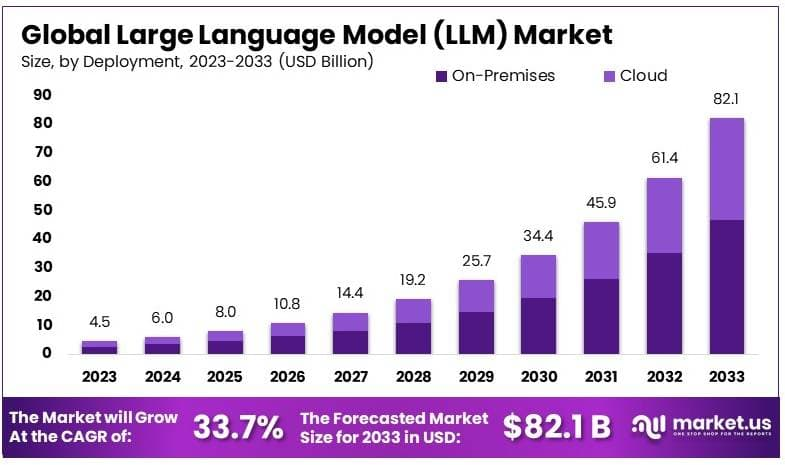
Source: Market.us
The LLM market is expected to grow at a CAGR of 33.7% and reach $82.1 billion by 2033, which is a clear indicator of the urgency with which brands should start LLMO.
Conclusion: Embracing the shift from SEO to LLMO
Large Language Models represent the next generation of how meaning and information will be expressed, contextualised, calibrated, and trusted. As SEO for LLMs transforms the discovery process, visibility will take on a different definition, less on being “ranked” first, but being recognised as the best-informed in the context expected.
Companies that invest in LLMO will come to represent an increasingly dominant presence in defining the digital landscape of the future. The task is simple: develop credible and structured content that can be trusted by both users and AI.
FAQs:
LLMO, short for Large Language Model Optimisation, entails enhancing your brand’s exposure within AI-generated answers, ensuring your brand is mentioned, cited, and accurately portrayed in conversational answers.
Traditional SEO is keyword and link-based, and focused on ranking higher on the SERPs. LLM SEO, on the other hand, is focused on factual accuracy, authority, and contextual clarity to help AI systems recognise and accurately cite your content.
LLM SEO ensures that your brand remains visible within AI-based search results, builds credibility, and helps improve how large language models recognise and trust referring to your business.
AI is a wider concept that includes LLM and other technologies, while LLM stands for Large Language Model and is a specific kind of AI system that is trained on language data to process and generate text.
ChatGPT is a generative AI application that is built on the LLM architecture and is capable of processing human-like language in response to a question, request or prompt.