Meta Andromeda Update: What Changed, Its Impact on D2C Ads, and How AI Is Scaling Performance
1st January 2026 / in SEO / by Ruturaj Kohok
- Reading time: 08 mins 09 Sec
Ad tech specialists who have recently run Meta ad campaigns have likely noticed a change in how their ads perform. For example, ads that were once extremely effective because D2C brand marketers defined their audiences very carefully might not deliver the same level of performance today. Similarly, creative tests conducted last year may be unpredictable today.
The changes are not short-lived trends; they are the result of the most significant ad algorithm change in the history of Meta ads, the Meta Andromeda Update, which fundamentally changes how digital marketing campaigns are delivered to users on Facebook and Instagram.
Where an advertiser would have defined the audience, now with the new algorithm, Meta AI will determine which ad will be shown to which user in real-time. For modern D2C brand marketers, this represents a complete reversal in how they view advertising and has implications for many other aspects of their Facebook ad strategy. Creative quality, emotional connectiveness, and the importance of data feedback loops have become more important than precise audience targeting with this new algorithm update.
In this blog, we will explore what has changed with the introduction of the Meta Andromeda Update, how it impacts D2C brands, how AI is scaling performance for brand marketers who are open to adapting it, and what it means for your Facebook marketing strategy.
What Is Meta Andromeda and Why Is It a Big Deal?
The Meta Andromeda Update signifies a total re-engineering of the Meta ad engine to provide a better advertising experience for its users. It was launched in the global markets, across the US, EU, and India, in late 2025. As a result of this updated advertising delivery engine, the way that advertisements are delivered, filtered, and matched has changed fundamentally from the previous model.
Before this algorithm update, advertisers would define their audiences on Meta; however, with the new update, it is Meta AI that will determine which ad creative would be the most relevant and impactful to which user, in real time.
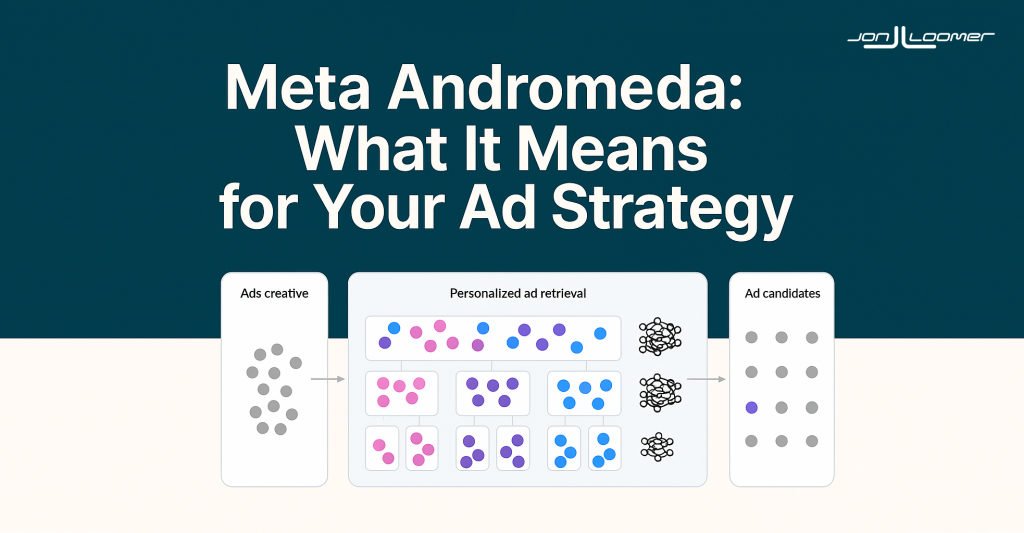
Source: Jon Loomer Digital
At its core, Andromeda is a personalised ads retrieval engine. It filters out the most relevant creatives for each user from the millions of available ads, based on the users’ behavioural intents and creative signals.
In simpler words, instead of advertisers telling Meta who should see their ads, Meta’s AI now decides it based on what the ads actually contain. This takes away targeting, leaving ad tech specialists to focus more on the quality and impact of the creative they use.
The Meta Andromeda Update aligns with Mark Zuckerberg’s AI-first vision that outlined the overarching theme of how the future of advertising would become more personalised, predictive, and contextual.
How Meta rebuilt its ad delivery engine?
Previously, Meta’s ad platform relied on advertisers to create Facebook ads, select the target audience and use their own parameters to show ads to the right people through Meta’s Ads Manager. Advertisers used demographic characteristics, interests, or lookalike audiences, and hoped it was the right target audience for their ads.
Andromeda turns this approach upside down.
It is now entirely based on how the AI analyses the visuals, copy, speed, emotional tone, and design and matches those indicators with users in real-time. The focus of Facebook ad campaigns has shifted from identifying customers to determining their intent with Andromeda.
The system utilises deep learning and sequence learning to predict what users need. For instance, if a user schedules a ski trip, Andromeda is able to show ads for winter gear and thermal clothing not based on previous interests but based on contextual relevance. This is an example of data-driven marketing done on a large scale.
The role of NVIDIA and MTIA Chips:
Strong hardware capabilities support Meta’s Andromeda Update. By leveraging NVIDIA’s Grace Hopper superchip paired with Meta’s own proprietary Training and Inference Accelerator (MTIA) chip, Meta can process millions of ad options in a fraction of a second.
Developed and deployed from Meta Headquarters in Silicon Valley, this infrastructure enabled a 10,000x increase in model complexity for ad retrieval. According to Engineering at Meta, the team was able to design deep neural networks using significantly more computational complexity and far greater levels of parallelism than before, enabling them to capture more complex, higher-order interactions between users and the ads. With these advances, Meta increased the number of end-to-end model inference queries per second by over 3x.
These advancements enable Andromeda to process the vast numbers of creative variants generated through AI-powered advertising tools, which previous systems had difficulty with.
Why isn't this just another algorithm update?
Traditionally, algorithm tweaks have been minimal; however, Andromeda marks an evolution within how Meta learns, tests, and optimises ads based on everything from user engagement data to the frequency of impressions. The previous method of retrieval was to use separate models combined with direct strategies when designing how personalisation works.
The old method struggled to keep up with the demand for AI Facebook ad variations, which made creating a new method or system for handling creative content necessary. As such, Andromeda has been developed to serve as a new solution designed specifically for the increase in creative abundance.
Facebook marketers who have switched their campaigns to this new way of targeting & creative presentation have an average 8% to 10% performance improvement, while those who continue to use manual audience targeting techniques experience decreased efficiency.
How has Meta ad targeting changed under Andromeda?
From audience targeting to creative matching:
The times when you could show your ads to specific people based on their age, gender, and a variety of other factors, based on custom audiences, lookalike audiences, and detailed targeting, are gone. These targeting options are merely suggestions; your ad success is now determined by Facebook ad creatives. This change means that the images, videos, text, and offers effectively replace the audience targeting that Facebook marketers used to do.
Think of this as this: rather than telling Facebook, “I want to target women aged 25-45 who love to work out,” all you say is, “here is my marketing material that displays the workout gear. You show this to the audience that is most likely to purchase my items.”
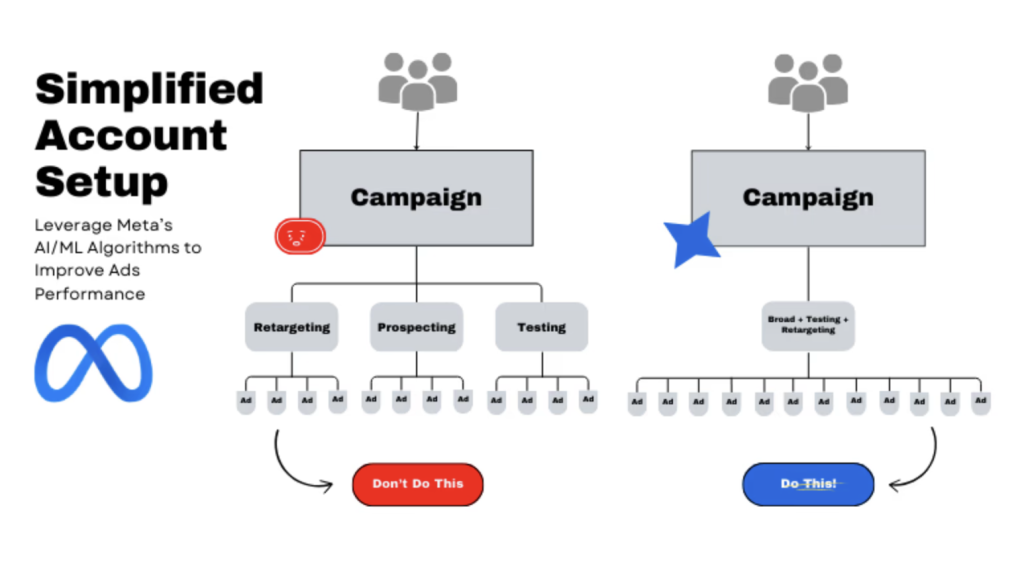
Source: HT&T Consulting
According to HT&T Consulting, Andromeda moves from fragmented audience-based Facebook ad campaign structures to simplified, AI-driven campaigns where creative diversity guides delivery.
Why does broad targeting now work better?
Andromeda is even better at identifying relevant ads when advertisers set broad targeting limits. It recommends that clients embrace broad targeting and use placements like Advantage+, so the algorithm can create and optimise their Meta ads using the same criteria.
Creating ads across a broader range of users provides advertisers with access to an entirely new level of insights and patterns. Broad targeting is driving high levels of success for early adopters, and with their ability to create creative diversity, they are seeing ROAS levels of 12-18% higher, compared to narrow targeting ads. The difference is substantial and represents a huge leap in performance benefits from giving AI its full capabilities.
Why do stacked interests and lookalikes don’t work anymore?
Interest stacking and micro-segmentation exhibit past behaviours, but do not indicate current intentions. Lookalike audiences are still viable; however, they no longer serve as criteria boundaries, but rather as performance benchmarks.
When audiences are over-engineered, the lack of data density will cause your algorithm to learn at a slower pace and perform at a lesser rate.
Why is Facebook ad creative now the most important factor?
Creative as a signal, not a message:
Meta’s advertising system now uses creativity to connect people with ads based on what they want to see, rather than a campaign’s targeting settings. In other words, there is no longer any separation between the “what” and the “who” of targeting with a Facebook ad campaign; there is a direct relationship between the creative content of the ad imagery, tone, messaging, format, pacing, emotions, and cues and the people who will be shown that ad.
Think of every piece of content as a key to opening up the different segments of audience members that are best suited for it. Therefore, the Facebook ad creative of a particular ad serves two purposes. First, it communicates the brand message; and second, it informs Meta ad systems about which types of users are most likely to respond to that specific message.
How does emotional tone influence delivery?
Emotion plays a critical role in how the best marketing campaigns perform; it determines what users see on their platforms. Meta uses its AI to determine the emotional relevance of the videos, audio, and text of an ad; therefore, emotional resonance is now a key factor in creating effective Facebook ads, rather than being optional.
The emotional tone of an ad determines which audience segments it will reach. Thus, brand marketers should create advertisements with different tones for their ads.
The rise of concept-level testing:
Instead of analysing individual parts separately, concept-level testing considers the entire Facebook ad creative set as one unit to evaluate how well it will perform. The most important thing to consider when conducting concept testing is to evaluate larger concepts against small variations. By doing so, you can generate clearer signals for the algorithm to train itself upon.
Why are micro-variants no longer effective?
Micro-testing, which involves minor tweaks, has been proven to be ineffective. Instead of being identified as unique, Andromeda will treat all of these small changes as the same ad, resulting in limited reach and increased cost to the Facebook marketers. For this reason, Meta now requires 8 to 15 distinct creative variations within every campaign.
How can D2C brands adapt their Facebook strategy?
Audit your creative library for variety:
Review your existing ad assets and determine whether they offer a diverse range of solutions to Meta’s algorithm. Group your existing advertising assets according to concept; then, identify areas where you need to enhance your creative representation. Using a variety of ads can help mitigate advertising fatigue while allowing you to test different formats/styles/types.
Use Advantage+ and automation tools:
Advantage+ is a campaign solution that utilises a machine-learning strategy to optimise audience, placement, and budget for your advertising. Unlike traditional campaigns, the Advantage+ system can automatically convert product photos into video ads, create headlines for you, and resize images for placement based on the user’s view.
Track new metrics like hook rate and fatigue:
Track creative performance using different specialised metrics, including hook rate, hold rate, and engagement rate. Look out for signs of creative fatigue; for example, if the CTR drops by 15% within 7 days, or if the frequency is higher than 3.0. Also, Meta’s similarity score for creatives helps determine whether your ads look too much like one another and allows you to change them to avoid drops in performance before they happen.
Feed clean data via Pixel and CAPI:
You should send tracking data to your teams via both Meta’s Pixel and Conversions API. The Pixel tracking of browser activity and the conversions API allows servers to track conversions regardless of ad blockers and iOS privacy changes. Meta’s AI uses the clean and accurate conversion data provided by both pixels and CAPI to optimise the performance of your campaigns.
Build a system for creative rotation:
Set a schedule for consistently refreshing your fall-off creatives before performance begins to decline. One way to launch your Facebook ad creative is to start with three different and distinct concepts, with one new variation added to the mix each week. This covers every aspect of creative ideation, production, testing, and optimisation.
Meta Andromeda: Reshaping the Future of Meta Ads Through AI
With the release of Andromeda, Meta has completely changed the way D2C brand marketers create Facebook ad campaigns. Previously, audience targeting was based on demographics and interests, but with Andromeda, the focus is now on delivering relevant and intent-specific ad content.
The introduction of Andromeda marks a turning point in social media advertising; the businesses that can evolve quickly will have the upper hand over the businesses that cannot. Facebook marketers need to begin concentrating on producing high-quality creative, utilising automation and developing an organised process for producing their creative.
While Facebook marketers may lose some control over who views their ads through the functionality provided by Andromeda, they will also have access to a plethora of Facebook ad tools that allow them to match their creative to the most appropriate audiences. Now the issue is not whether or not you should adapt to Andromeda, but rather how quickly you can adapt your current Facebook marketing strategy to take advantage of all that Andromeda has to offer.
FAQs:
Andromeda is Meta’s AI ad delivery solution that combines both real-time user behaviour & creative signals to match ads dynamically, prioritising relevance, performance, and intent.
In India, Meta’s AI can be accessed; however, the features available will vary based on regulations, language support, and platform readiness across regions globally.
Meta started the deployment of the Andromeda update towards the end of 2024 and has been doing so in multiple phases around the world until late 2025.
Advantage+ is a feature designed to automate campaign-level processes, whereas Andromeda is the AI system that determines which ads appear, making Advantage+ tools beneficiaries of Andromeda’s intelligence at scale, globally.
Under Andromeda, creative content should be refreshed at least every 2-4 weeks. YIt can be done sooner if you are seeing high frequency, lower engagement levels, or visible signs of creative fatigue in your target audience.