
From Chatbots to Predictive Analytics: AI Applications in Fashion Ecommerce
30th January 2026 / in Ecommerce / by Ruturaj Kohok
- Reading time: 9 mins 25 Sec
Artificial intelligence in ecommerce continues to revolutionise the way that businesses operate, and its influence on fashion ecommerce has expanded significantly over the last decade. Fashion incorporates elements of creativity, data, and rapidly fluctuating customer preferences more than any other ecommerce segment.
The ecommerce or retail fashion landscape is also marked with numerous SKUs, changing seasonal collections, and many different trends that can change how customers make purchases. Thus, ecommerce fashion brands encounter some of the most challenging problems and complexities in managing their businesses at scale.
At Nethority, we work closely with fashion ecommerce brands, D2C founders, and retail teams to implement AI-driven personalisation, predictive analytics, and data-led growth strategies. The insights shared in this article are based on hands-on ecommerce transformation projects combined with research from leading global retail and technology firms.
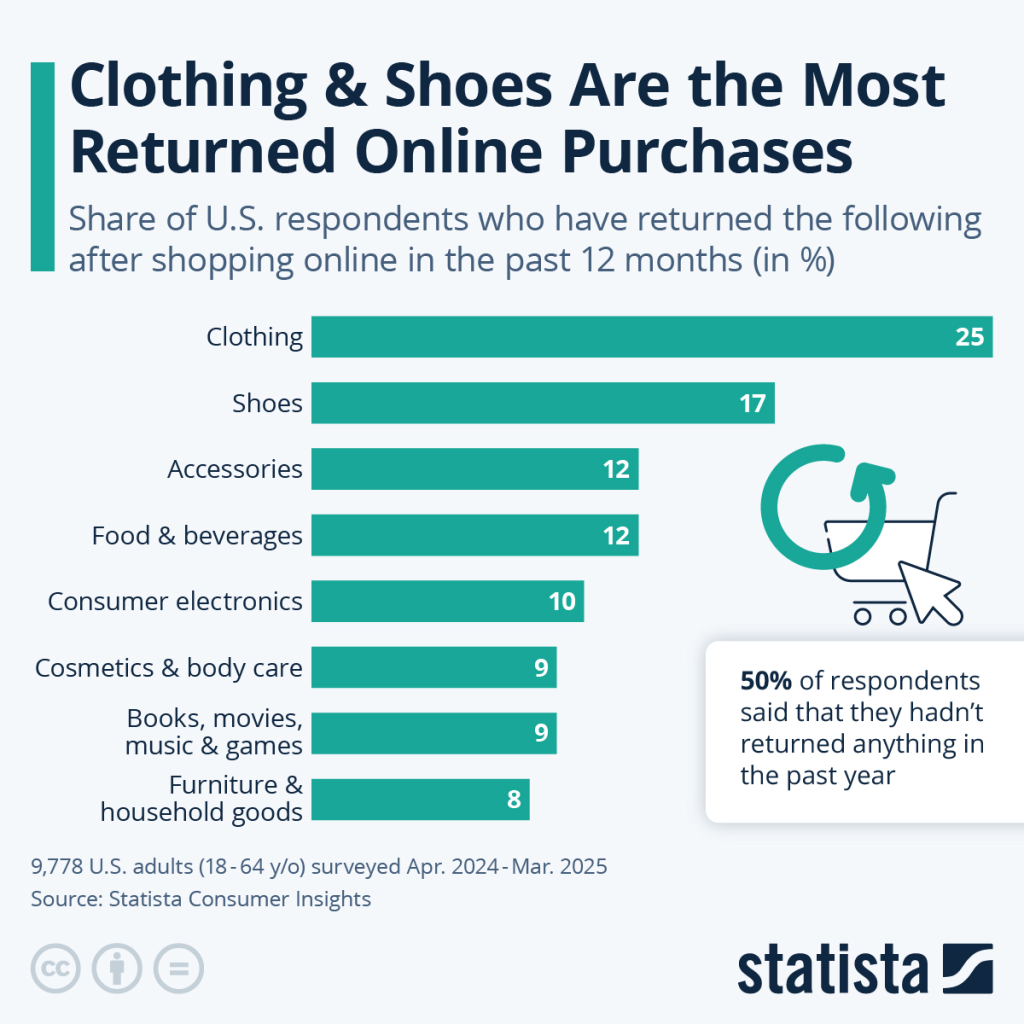
Source: Statista
According to Statista’s US ecommerce returns report published in 2024, covering the period from April 2024 to March 2025, the most returned online purchases in the US were clothing and shoes, at 25% and 17%. Other returned items include accessories and food & beverages at 12% each, consumer electronics at 10%, cosmetics and body care and books, movies, music & games at 9% each, and furniture and household goods at 8%.
At Nethority, our experience with fashion ecommerce implementations shows that AI-driven personalisation, AI-based size recommendations, and predictive analytics are no longer optional but essential for reducing returns and improving profitability. Fashion ecommerce companies such as Zara, Myntra, ASOS and Lyst are all utilising AI in their businesses significantly.
In this blog, we will discuss the impact of AI in ecommerce, along with AI chatbots, AI-powered product recommendations, predictive analytics, and generative AI in fashion ecommerce. We’ll also talk about how fashion brand founders, ecommerce managers and digital transformation leaders are utilising AI for data-driven decision making.
The Role and Benefits of AI in Fashion E-commerce:
What Is Artificial Intelligence in Ecommerce(Fashion)?
Artificial intelligence in ecommerce for fashion brands is defined as a set of systems that can quickly analyse large amounts of data, learn from patterns, and make decisions or recommendations with minimal human involvement.
To accomplish this in practice, AI for ecommerce uses machine learning tools such as supervised, semi-supervised, and unsupervised learning, recommendation systems, natural language processing (NLP), reinforcement learning, and predictive data analytics models to enhance marketing, selling, and managing fashion products online.
These systems analyse several data sources, such as customer behaviour, product catalogues, inventory, and sales data, in order to automate decision-making and improve customer experience. In addition, these systems help ecommerce fashion merchandisers work more efficiently.
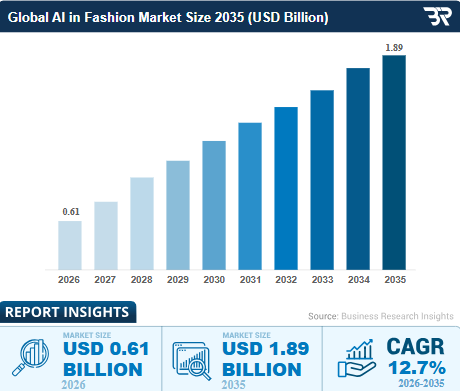
Source: Business Research Insights
According to the Global AI in Fashion Market Size 2035 report published by Business Research Insights, the market size of artificial intelligence in ecommerce in the fashion industry is expected to be $0.61 billion in 2026, which will grow to $1.89 billion by 2035, with a CAGR of 12.7%. This growing market makes it important for retail analysts to go for the application of AI in ecommerce as soon as possible.
In the context of fashion ecommerce, artificial intelligence typically includes machine learning models, recommendation engines, predictive analytics systems, and generative AI tools applied across merchandising, marketing, inventory management, and customer experience.
Why Fashion Is a Natural Fit for AI?
The fashion retail industry is uniquely suited to AI adoption because it sells visual products that depend heavily on subjective perception and are continually changing. Many fashion brands leverage multiple digital marketplaces, manage multiple seasonal collections, and reach customers around the world.
For instance, ASOS uses AI to understand customer browsing history and purchase behaviour, allowing it to identify emerging trends early. In addition, AI trend forecasting platforms improve the brand’s ability to produce certain styles, colours, and silhouettes by helping brands eliminate questionable choices and waste.
In practice, fashion brands benefit from AI because it allows them to respond to shifting consumer preferences faster than traditional planning cycles, particularly in trend-sensitive categories such as fast fashion and occasion wear.
Therefore, for the players in the fashion marketplace and the direct-to-consumer (D2C) ecosystem, AI can scale operations without complexity.
AI Chatbots and Virtual Assistants for Fashion Ecommerce:
How AI Chatbots Improve Customer Experience in Fashion Ecommerce?
AI chatbots for ecommerce are a fundamental component of all major ecommerce platforms, such as Shopify, Magento (Adobe Commerce), WooCommerce, Salesforce Commerce Cloud, BigCommerce, Amazon, and Flipkart today. The main purpose of using AI chatbots is to manage high volumes of customer interactions.
AI chatbots can be used for customer support, sales assistance, and abandoned cart recovery across high-volume ecommerce operations. Customers can use it to track orders, determine the correct product size, receive delivery updates, or find out how to return an item. All of this is possible because of conversational AI combined with natural language processing models.
In real ecommerce implementations, chatbots deliver the highest value when they are integrated with order management systems, product catalogues, size charts, and return workflows rather than operating as standalone FAQ tools.
Read more: AI Chatbots in Ecommerce: How They Improve Sales and Customer Support
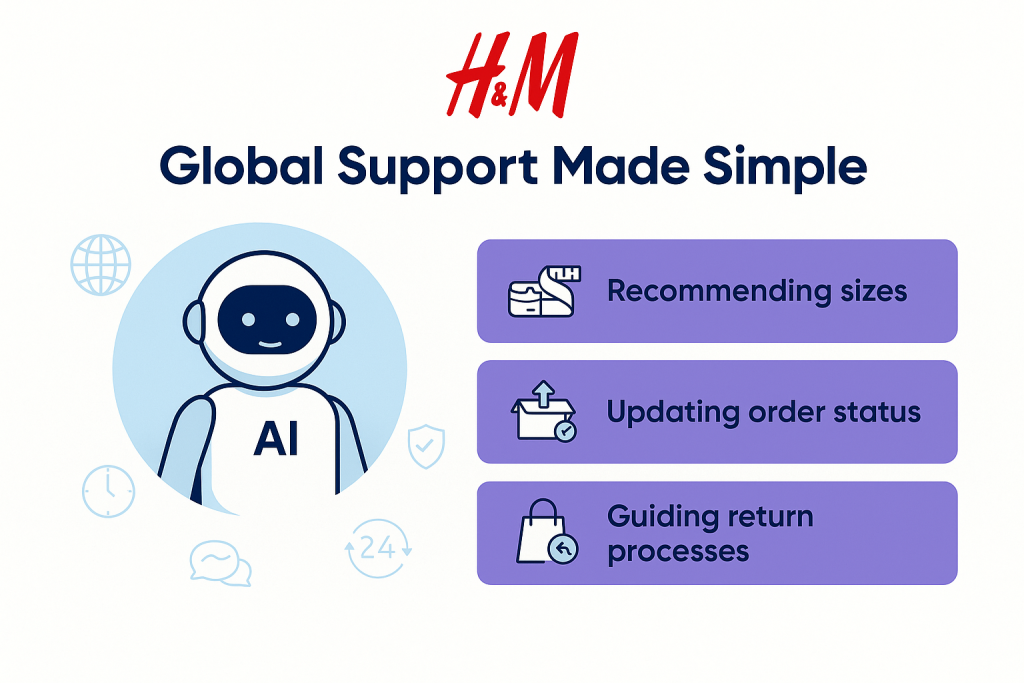
Source: Yep AI
According to Yep AI, an example of chatbots being used successfully is H&M, where the average response time to customer inquiries via chatbot was reduced by almost 50%, greatly improving customer satisfaction. In terms of E-E-A-T (Experience, Expertise, Authoritativeness, and Trustworthiness), these applications show their operational experience and technical knowledge to solve real customer problems.
AI Virtual Assistants for Fashion E-commerce: Styling and Shopping Guidance
In addition to providing customer service, virtual assistants within ecommerce are influencing customers’ shopping decisions. Styling assistants using artificial intelligence can suggest potential outfits based on the occasion, along with the customer’s past purchases and browsing habits.
Because customers can’t physically try on clothes when shopping online, AI-based styling assistants are a valuable resource for consumers.
AI-based styling assistants and product recommendation engines, as provided by tools like Vue.ai and Syte, provide customers with the same support online as they would receive while shopping in a store. This creates confidence in customers’ decision-making processes, which ultimately leads to reduced return rates.
Business Impact of AI Chatbots and Virtual Assistants for Fashion Ecommerce Managers:
According to a study by Accenture and published by Action.bot, AI-powered chatbots have been shown to save businesses 29% in customer service costs, while increasing conversion rates by 10 to 15% according to studies conducted by various business analysts.

Source: Action.bot
For retail analysts and ecommerce managers, that is an invaluable return on investment. Automating customer interactions enables teams to work on significantly more important tasks, while also giving customers faster and more relevant assistance.
AI-Powered Personalisation in Fashion E-commerce:
AI Personalisation in Fashion Retail:
AI has transformed the ecommerce industry through personalisation, especially in fashion. Personalisation is utilised in fashion ecommerce through the use of browsing behavioural data, browsing patterns and purchasing behaviour to personalise the user experience.
From personalising experiences to developing curated collections and utilising targeted emails, Nethority uses AI in the fashion ecommerce industry to provide personalised experiences. Real-time personalisation at scale has become possible through Customer Data Platforms (CDPs), such as Dynamic Yield, Nosto and Salesforce Interaction Studio.
Read more: AI-Driven Personalisation: The Key to Better Online Shopping Experiences
Source: Wiser Notify
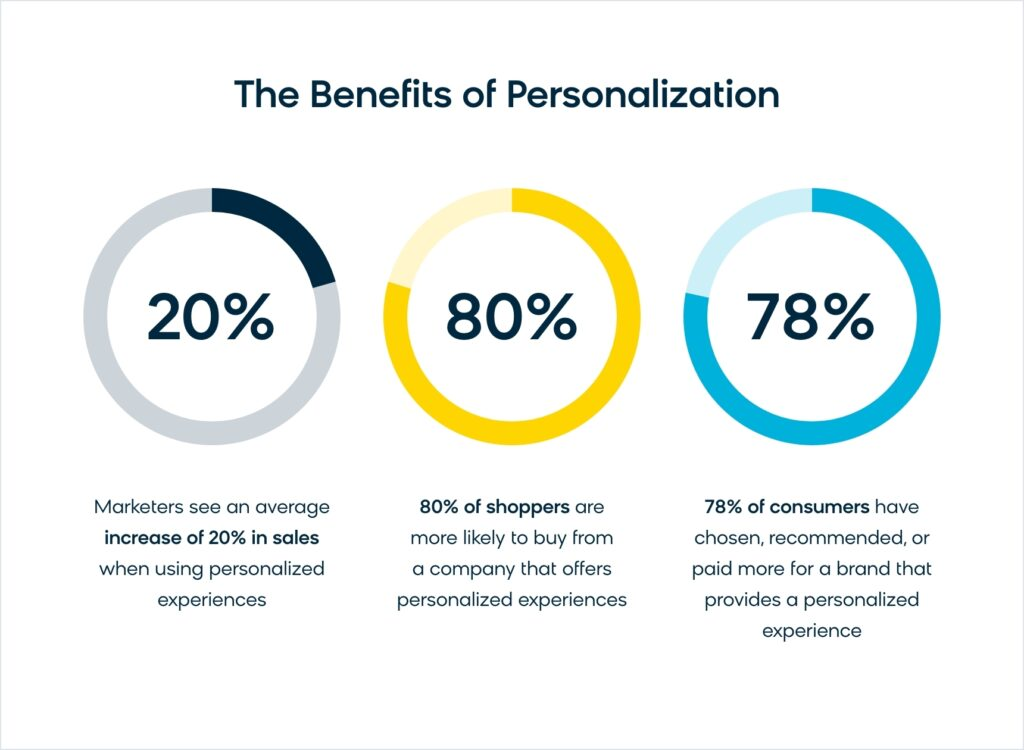
According to an ecommerce personalisation performance analysis published by Wiser Notify, personalisation results in a 20% increase in sales, whereas 80% of customers are more likely to buy because of personalised experiences, and 78% of customers have selected, suggested, and paid more for a brand that offers personalisation.
AI-Powered Product Recommendations for Fashion Ecommerce:
AI-powered product recommendations utilise machine learning to provide users with product recommendations. Furthermore, retail ecommerce companies such as ASOS and Zalando have effectively deployed product recommendation engines via “you may also like” or “complete the look.”
Machine learning models utilise product similarity, customer preferences, and context signals to provide product recommendations. As a result, online fashion stores get increased average order values and a higher rate of discovery.
Customer Retention in Fashion Ecommerce Through AI and Data-Driven Experiences
Artificial intelligence in ecommerce allows for consistent, relevant recommendations and content, thus creating long-term relationships and increasing customer retention. The use of data-driven personalisation gives fashion brand founders a competitive edge as they compete with so many other online fashion stores/digital marketplaces.
Predictive Analytics in Fashion E-commerce for Inventory, Marketing, and Sales
What Is Predictive Analytics in Fashion E-commerce?
Predictive analytics in ecommerce uses historical data and statistical models to forecast future trends, such as demand, sales, and customer behaviour, which is important for the fashion retail industry to anticipate rather than react to trends.
In fashion retail, predictive analytics models are most effective when they are continuously retrained using real-time sales velocity, promotional calendars, and external demand signals rather than relying only on historical sales data.
Many data scientists and digital transformation leaders emphasise the need for predictive data analytics and its essential role in any modern-day retail business. There are many ways that retailers utilise predictive analytics, from demand forecasting tools to inventory optimisation software to sales analytics systems.
Read more: The End of Keywords? Semantic + Predictive SEO for 2026 and Beyond
AI Demand Forecasting and Inventory Planning in Fashion Retail:
One of the largest challenges for fashion ecommerce retailers is the mismanagement of inventory. Predictive analytics software can help retailers determine their sales patterns over time by assessing past sales, seasonality, and market signals and provide more accurate demand forecasts.
Source: The Business Research Company
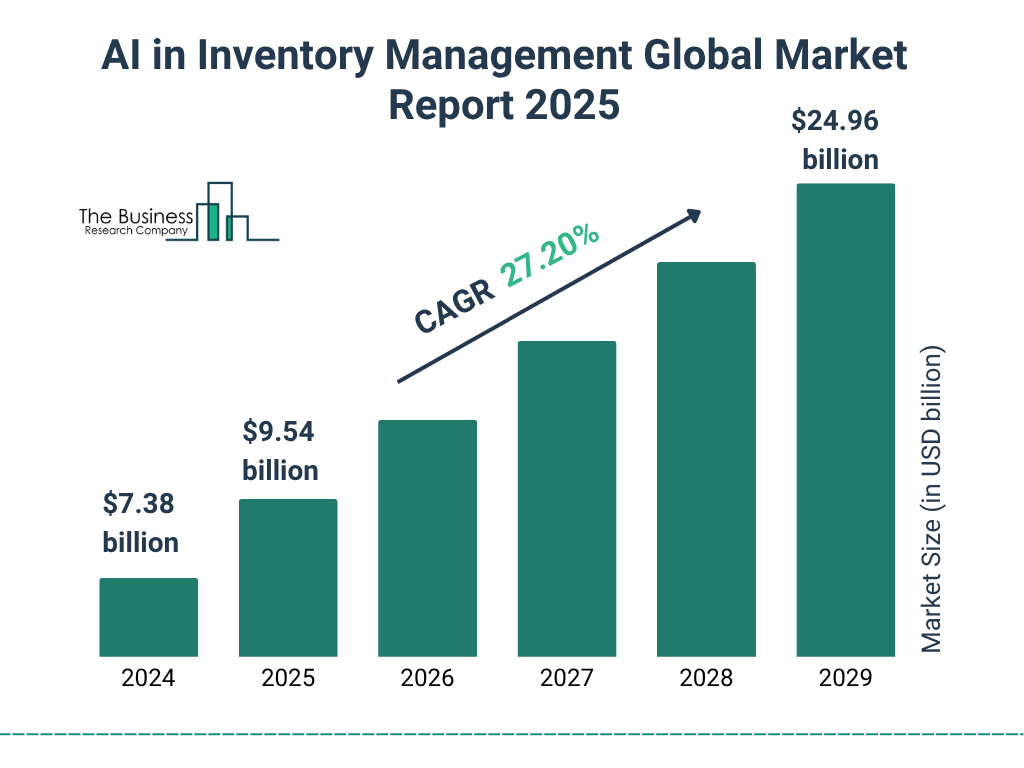
According to a 2025 industry report published by The Business Research Company, the global market size for the utilisation of AI in inventory management in 2025 was $9.54 billion, which is expected to reach $27.96 billion by 2029, with a CAGR of 27.2%. This shows how more and more retail analysts are increasingly using AI in their inventory planning.
When utilised as part of an inventory management system, AI can help reduce stockouts, eliminate excessive markdowns and provide for a more data-driven, strategic approach to making inventory decisions.
Predictive Analytics for Fashion Marketing and Sales:
Predictive analytics provides informative insights to marketing strategies by anticipating how successful a particular campaign may perform, when the best time to distribute discounts is, and the degree of price elasticity within the market.
Artificial intelligence and machine learning tools such as Salesforce Einstein and Adobe Sensei allow brands to ensure that they utilise their marketing budgets effectively, resulting in better returns on ad spend. Alternatively, it also supports the rise of predictive SEO, helping predict organic trends and act accordingly in the present.
Read more: The End of Keywords? Semantic + Predictive SEO for 2026 and Beyond
AI Trend Forecasting in Fashion Retail Industry:
AI trend forecasting in fashion involves large amounts of data from social media, search engines and sales information to predict what will likely be popular in fashion trends in the near future. By identifying and tracking visual trends in conjunction with keywords and how consumers engage on social media platforms like Instagram and Pinterest, brands can better inform themselves in anticipation of the trends, as opposed to being reactive when trends have already happened.
Applications of Generative AI in Fashion Ecommerce:
What Is Generative AI in Fashion Ecommerce for Content, Design, and Catalogue Creation?
Generative AI in fashion ecommerce refers to systems that utilise artificial intelligence to generate content rather than only analyse existing data. It includes product descriptions, marketing content, catalogue images, ad images, and more. Many users are leveraging AI tools such as DALL·E, MidJourney, Runway, and Vue.ai to enable efficient catalogue scaling and explore new creative opportunities.
While generative AI accelerates content and catalogue creation, human oversight remains essential to maintain brand accuracy, compliance, and visual consistency.
Source: Demand Sage
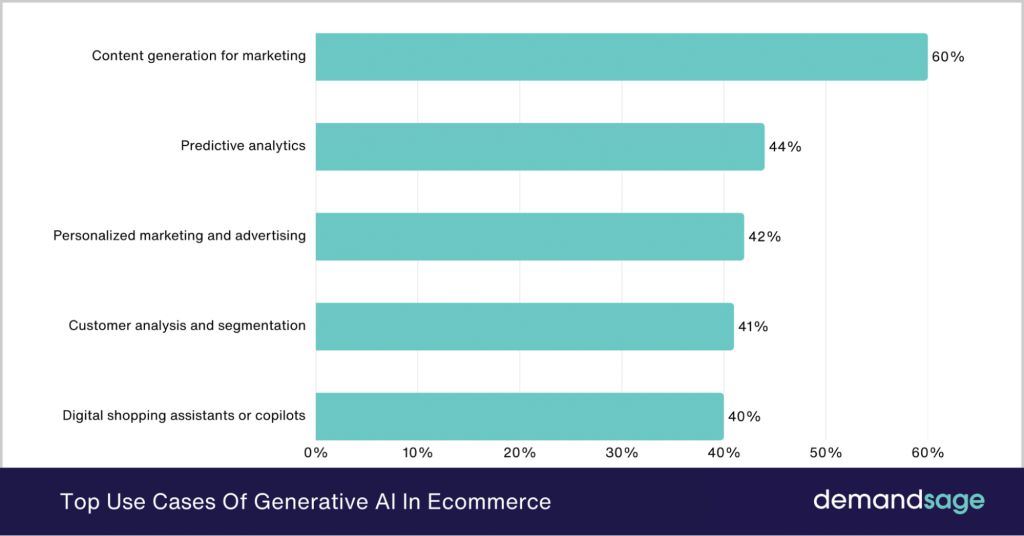
According to a Demand Sage report, generative AI is most used for content generation for marketing at 60%, predictive analytics at 44%, personalised marketing and advertising at 42%, customer analysis and segmentation at 41%, and digital shopping assistants or copilots at 40%.
Generative AI Applications Across the Fashion D2C Ecosystem:
For brands within the D2C ecosystem, generative AI allows for faster and more efficient product launches and fosters brand storytelling consistency throughout the customer journey. Generative AI has become key in ecommerce marketing for content creation, personalisation, customer interactions, and campaign optimisation. Through AI-enhanced content creation, brands can launch new SKUs without having to hire additional creative staff, thereby increasing overall efficiency without compromising quality.
Read more: Generative AI in E-commerce Marketing: Opportunities in 2026
AI Infrastructure and Systems Behind Fashion Ecommerce Brands:
Core Systems Behind Fashion E-commerce Brands:
Generative AI in fashion ecommerce cannot operate independently without an underlying AI infrastructure and system architecture. Fashion ecommerce brands leverage integrated Customer Data Platforms (CDP), CRM software, and ecommerce analytics tools with their existing ecommerce operating platforms, be it Shopify Plus, Salesforce Commerce Cloud, Magento, or BigCommerce, to determine how best to deliver AI-powered ecommerce operations.
In enterprise fashion ecommerce environments, AI adoption often underperforms when data pipelines, governance frameworks, and cross-functional collaboration are not aligned with business objectives.
Collaboration Between AI Teams and Business Managers in Fashion Ecommerce:
Cooperation between AI and business management personnel is critical to the success of any business that adopts artificial intelligence technology. Cross-functional teams ensure the conversion of AI-generated data into tangible actions, thereby increasing the trust and expertise of the team.
The Future of AI-Driven Fashion E-commerce:
AI as a Digital Transformation Driver:
AI has been at the forefront of retail digital transformation and allows fashion retailers to operate more productively, quickly adapt to changing market conditions, and ultimately provide improved customer experiences.
According to Gartner’s retail technology adoption research, it is projected that within the next five years, 91% of the world’s leading retailers will adopt artificial intelligence solutions to further enhance their existing core retail operations.
Future AI Priorities for Fashion Brands:
Fashion retailers will focus on implementing AI-based tools for demand and trend forecasting using predictive intelligence technologies. This will enhance the customer experience using unified customer experience data and increase the effectiveness of the company’s merchandising functions through the usage of advanced AI solutions. These capabilities will be the determining factors of competitive advantage in the global fashion market.
According to an article published by SuperOffice CRM about types of customer service software, the key benefits of utilising a customer service software includes increase in retention and customer lifetime value (CLTV), improved communication, 360 view of the customer, increased productivity and lower costs, enhanced support for customers, and monitoring and tracking customer service KPIs.
Final Thoughts: Leveraging AI for Fashion Ecommerce Success
AI has impacted fashion ecommerce significantly through AI chatbots, personalisation, predictive analytics, and generative AI. For this reason, Nethority nudges fashion brands towards data-driven ecommerce, which is no longer optional but foundational in their business strategy.
Fashion brand founders, ecommerce managers and digital leaders who invest in AI from today onward will increase their opportunities to scale responsibly, change quickly and establish a greater level of connectivity with customers, leading to better customer retention, as the competitive online environment continues to evolve.
FAQs:
Fashion ecommerce refers to selling apparel online through a website or on a marketplace using product catalogues, payments, shipping, and returns to complete customer orders.
In fashion ecommerce, AI is used to enhance personalisation, product recommendations, chatbots, search functionality, pricing, fraud detection, and predictive analytics for both shopping experiences and efficiency in business operations.
Key applications for AI in fashion ecommerce include chatbots, virtual assistants, recommendation engines, demand forecasting, inventory optimisation, trend forecasting, visual search, and customer segmentation to assist in ongoing customer engagement.
AI predicts trends in fashion by analysing consumer behaviour data on social media platforms, search engines, sales data, and product attributes to identify early indications of new product demand.
Ada, Zendesk AI, Intercom, Gorgias, and Drift are some of the more popular options for AI chatbots. In addition, there are also retail-specific tools available, such as Vue.ai and Syte, which assist with product discoverability.