
How AI Is Revolutionising Ecommerce Team Operations
5th February 2026 / in Ecommerce / by Ruturaj Kohok
- Reading time: 9 mins 25 Sec
Ecommerce has evolved to be much more than simply listing products & running ads; today, comprehensive ecommerce operations that include inventory planning to order fulfilment and customer experience to performance reporting and inter-departmental coordination in an increasingly competitive digital world.
As brands scale, the biggest limiting factor in their ability to grow and succeed is the speed at which teams can identify issues, take action, and execute across the ecommerce platform without errors or delays.
In this context, AI in ecommerce team operations refers to the use of artificial intelligence technologies such as machine learning, predictive analytics, workflow automation, and generative AI to manage and optimise inventory planning, order fulfilment, customer experience, marketing operations, and internal coordination. Rather than functioning as a separate system, AI increasingly operates as an embedded intelligence layer across ecommerce platforms and connected operational tools.
Source: Exploding Topics
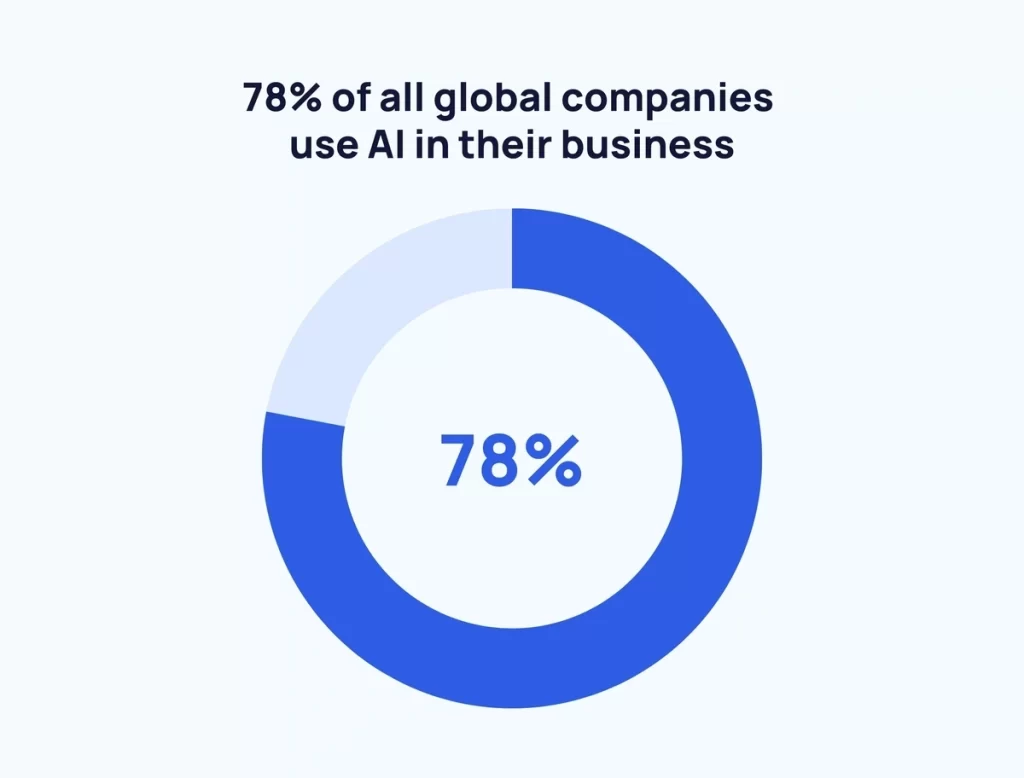
According to a recent study by Exploding Topics, 78% of all global companies utilise AI in their business operations. For ecommerce teams, this signals a shift away from experimental AI adoption toward operational dependency, where AI is increasingly used to support daily decision-making across inventory, fulfilment, customer service, and performance reporting.
This shows that while there’s a rapid adoption of Artificial Intelligence in direct-to-consumer (D2C) businesses, Nethority, which works with ecommerce and D2C brands on operational strategy and digital transformation, recognises that this trend is accelerating across the global ecommerce market and beyond, where rapid, efficient, and data-driven decision-making directly impacts profit.
How AI Is Used in Ecommerce Operations Today?
From Manual Processes to Intelligent Automation:
Repetitive operational tasks such as inventory updates, customer support ticket routing, order reconciliation, campaign performance checks, and weekly reporting consume a disproportionate amount of time for ecommerce teams. In practice, operations teams often discover that these manual processes are also where the highest error rates and delays occur, especially as order volume and SKU complexity increase.
AI automation tools provide the greatest benefit when applied to these business operations because they combine data from order systems, marketing dashboards, CRM systems, and logistics systems and automatically trigger the appropriate action based on that data. As a result, there are fewer manual errors and missed updates, and better execution across the entire ecommerce business operation.
Where AI Fits Inside an Ecommerce Platform?
AI for ecommerce operations is not a stand-alone tool that is added after scale; it functions as an embedded intelligence layer within ecommerce platforms and their connected systems, including inventory management, CRM, marketing automation, and logistics software.
Source: Deloitte
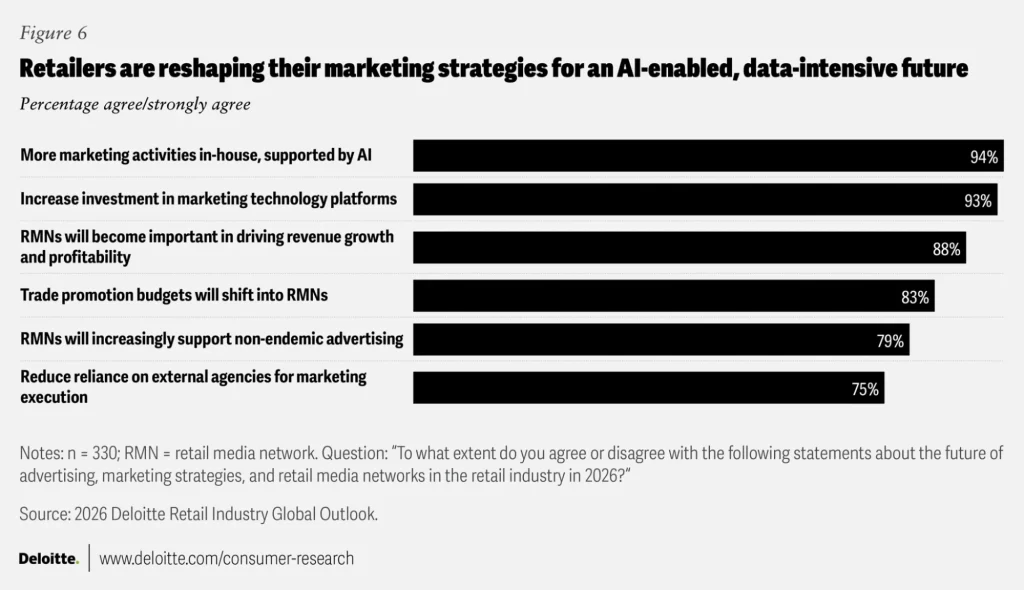
Many ecommerce operations managers, along with their marketing operations teams, are refining their strategies to include Artificial Intelligence for a data-intensive future. A recent Deloitte outlook indicates that 94% of all retailers expect to see an increase in their marketing activities moving in-house and being supported by AI, while 93% expect to see an increase in their investment in marketing technology platforms as well.
88% of these retailers feel that retail media networks will play a key role in their future revenue growth, making the need for closely-connected systems between commerce data, customer behaviour, and real-time data-driven decision-making even more critical than before.
This data reflects how ecommerce teams are restructuring operations around connected systems, where AI enables faster coordination between inventory, marketing, and customer experience rather than operating these functions in isolation.
Based on this, it’s clear that AI is no longer viewed as a stand-alone capability, but rather an integral part of the ecommerce platform that will be used to power forecasting, personalisation, and data-driven actions throughout the entire customer journey. This shift is also greatly visible in how brands are using generative AI across marketing and operations, where content, personalisation, and execution workflows are being increasingly powered by AI systems rather than manual effort.
Read more: Generative AI in E-commerce Marketing: Opportunities
The Role of AI in Ecommerce Team Operations:
How Operations Teams Work Differently With AI?
AI reshapes what constitutes good work for a team, instead of replacing them. As a result, ecommerce operations managers spend more time keeping the rhythm of operations alive, reducing the number of times that delays occur and managing exceptions.
Through AI insights, product managers can understand which products require more significant investment, which SKUs are creating friction and how to improve the catalogue.
Supply chain managers can base their purchasing decisions on demand signals and predictive trends rather than orders placed based on guesswork. Customer support teams can receive faster categorisation and smart routing of requests, as well as response assistance to improve service levels while reducing support backlogs.
Read more: From Chatbots to Predictive Analytics: AI Applications in Fashion Ecommerce
Marketing operations teams can align their launch calendars and marketing promotions with their stock; this enables them to avoid overspending on out-of-stock items. Data Analysts can spend less time cleaning datasets and have more time interpreting the data with AI assistance by minimising the need for manual data stitching.
AI specialists can have more opportunities to develop policies and procedures, improve the quality of AI models, design prompts and workflows, implement retail automation, and ensure that AI-driven commerce can be integrated safely across multiple tools used throughout the business for better operational efficiency.
However, as businesses scale, team structures evolve too. In this, AI plays a critical role in creating effective teams across various revenue stages.
AI as a Digital Teammate:
Ecommerce teams increasingly use AI as a digital teammate to monitor operational signals continuously rather than relying on periodic reports. In real-world operations, this often includes early detection of inventory risks, rising support ticket volumes, fulfilment delays, and sudden drops in product-level conversion rates, allowing teams to intervene before issues escalate.
Source: Exploding Topics
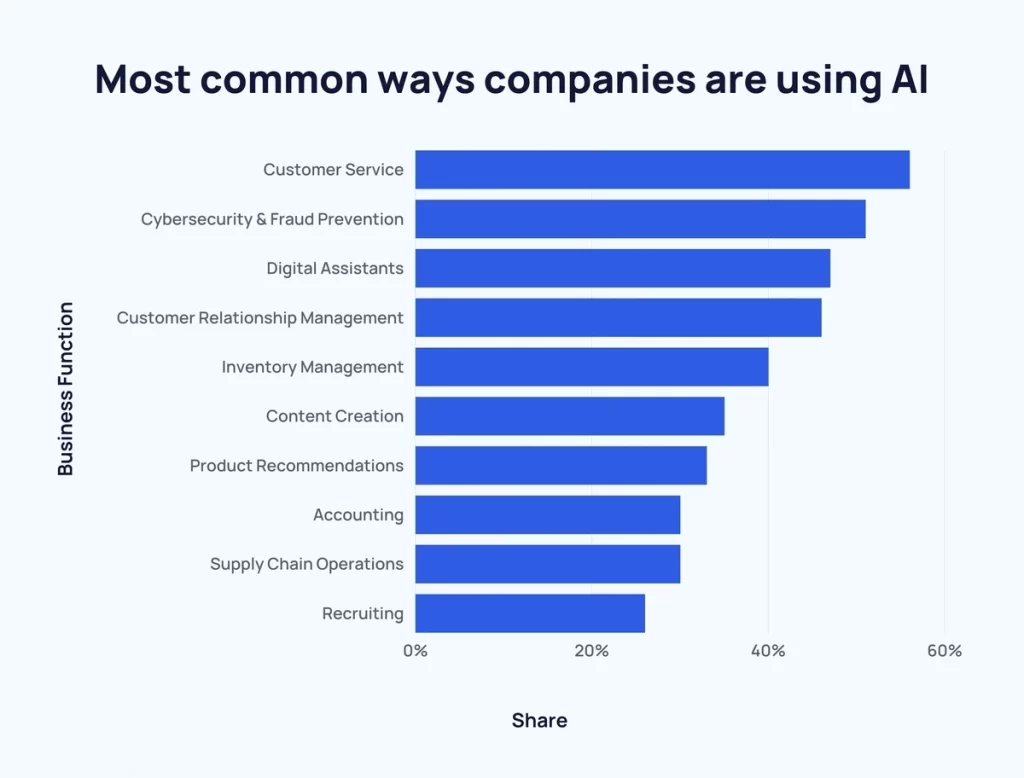
AI has become an indispensable part of ecommerce operations. According to a study by Exploding Topics, the most common ways companies are now using AI in their ecommerce business operations include 56% for customer service, 51% for cybersecurity & fraud prevention, 47% for digital assistants, 46% for customer relationship management, 40% for inventory management systems, 35% for content creation, 33% for product recommendations, 30% for accounting and supply chain operations each, and 26% for recruiting.
AI Solutions for Ecommerce Teams Across Functions:
Inventory and Supply Chain Operations:
Inventory problems generate costs on both ends of the spectrum; out-of-stock products lead to a loss in revenue, and over-stocked products cause cash-flow issues. AI-based demand forecasting tools used in ecommerce operations typically fall under inventory optimisation and replenishment planning software.
Platforms such as Netstock, Inventory Planner, Forecastly, Lokad, and StockTrim analyse historical sales data, seasonality, pricing changes, and campaign calendars to improve forecasting accuracy.
These are typically linked to inventory management systems, enabling businesses to make smarter restocking before inventory shortages occur, reduce impulse purchasing due to out-of-stock items and help them plan promotions around upcoming items that will be available for sale.
Customer Support and Experience Operations:
As customer expectations around delivery speeds continue to increase, the costs associated with operational errors increase as well.
Source: Cahoot.ai
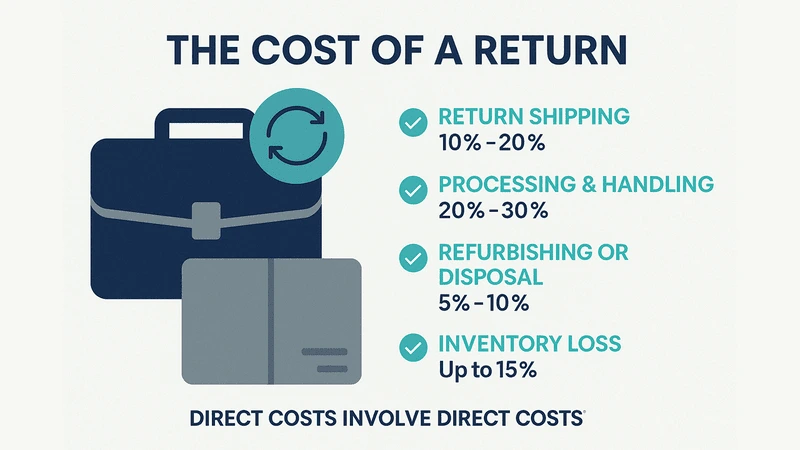
According to a study by Cahoot, inaccurate inventory positions or slow resolution of issues can cause returns to be significantly impacted with returns costs relating to shipping typically consisting of 10-20% of total return costs, while 20-30% relate to processing/handling costs for returned goods and inventory loss may account for as much as 15% of total lost inventory value.
Thus, real-time inventory visibility and responsiveness are not only crucial for improving customer experience, but they also play a key role in reducing overall direct financial losses for ecommerce operations teams.
Marketing and Revenue Operations:
AI also provides marketing operations teams with the opportunity to link their performance metrics to true business outcomes, rather than just optimising for ROAS. They can utilise AI analytics tools to analyse and optimise contribution margin, product-level profitability, and return rates.
As a result, operational efficiency will increase as fewer teams operate in a silo and more decisions are made with the same context. This kind of cross-functional intelligence will eventually become a core aspect of digital transformation as brands manage more SKUs, more channels and more complex fulfilment models.
This alignment between inventory, marketing, and customer experience is important, which can be achieved through AI personalisation, making it a key growth determiner for D2C businesses.
Read more: The Impact of AI and Personalisation on D2C Success
Benefits of AI in Ecommerce Operations:
Operational Efficiency at Scale:
AI for ecommerce provides marketers with a significant practical benefit in terms of reducing manual efforts across brands and teams by automating tasks. When routine work is automated, teams make fewer mistakes and complete tasks faster than they would through manual processes.
Therefore, utilising artificial intelligence in ecommerce is quickly becoming a productivity layer for many businesses. Many brands eventually realise that growth stagnancy is rarely caused by a lack of traffic or discounts, but by deeper operational gaps that ads alone cannot fix, which makes focusing on operational efficiency key for growth.
According to McKinsey & Company, over the next few years, executives plan to increase their investment in AI as organisations strive for ROI from both AI implementations and operating model improvements, which indirectly means fewer order cancellations, faster ticket turnaround times, tighter inventory management, and cleaner reports.
Read more: Ecommerce Challenges That Can’t Be Fixed with Ads or Discounts
Productivity Optimisation Without Team Burnout:
More than working harder, productivity optimisation is removing the time-consuming bottlenecks that slow down execution, such as reports that take longer than anticipated, waiting for approvals from team members, attempting to gather data from multiple systems, and the time it takes to manually update a status across multiple teams.
AI-enabled workflow automation can help teams maintain consistent execution as they begin to see an increase in the volume of orders being placed. For brands that have growth potential, this is important for scaling: building a company without having to add headcount at the same linear rate.
Data-Driven Decision Making Across Teams:
When AI is able to function with operational processes that provide good, clean product data, properly tagged items, accurate inventory counts, and unified reporting, it enhances the ability for teams to incorporate it into their decision-making process. The end result is faster identification of anomalies, which leads to fewer surprises and faster decision-making.
AI Tools for Ecommerce Team Productivity:
AI Automation Tools That Power Daily Operations:
Many times, productive ecommerce operations rely on using workflow management software, such as Asana, Monday.com, ClickUp, Jira, and ServiceNow, to manage the multitude of tasks that require coordination between team members, as well as ensuring accountability for each task’s completion.
However, with AI, it can automatically prioritise the highest priority tasks for completion, automatically generate an email/notification that will be sent to the concerned team member assigned tasks, as well as generate a summary of all changes that have occurred to existing tasks since the last review. Team members feel as though they are spending less time coordinating work and more time getting work done.
Source: LinkedIn
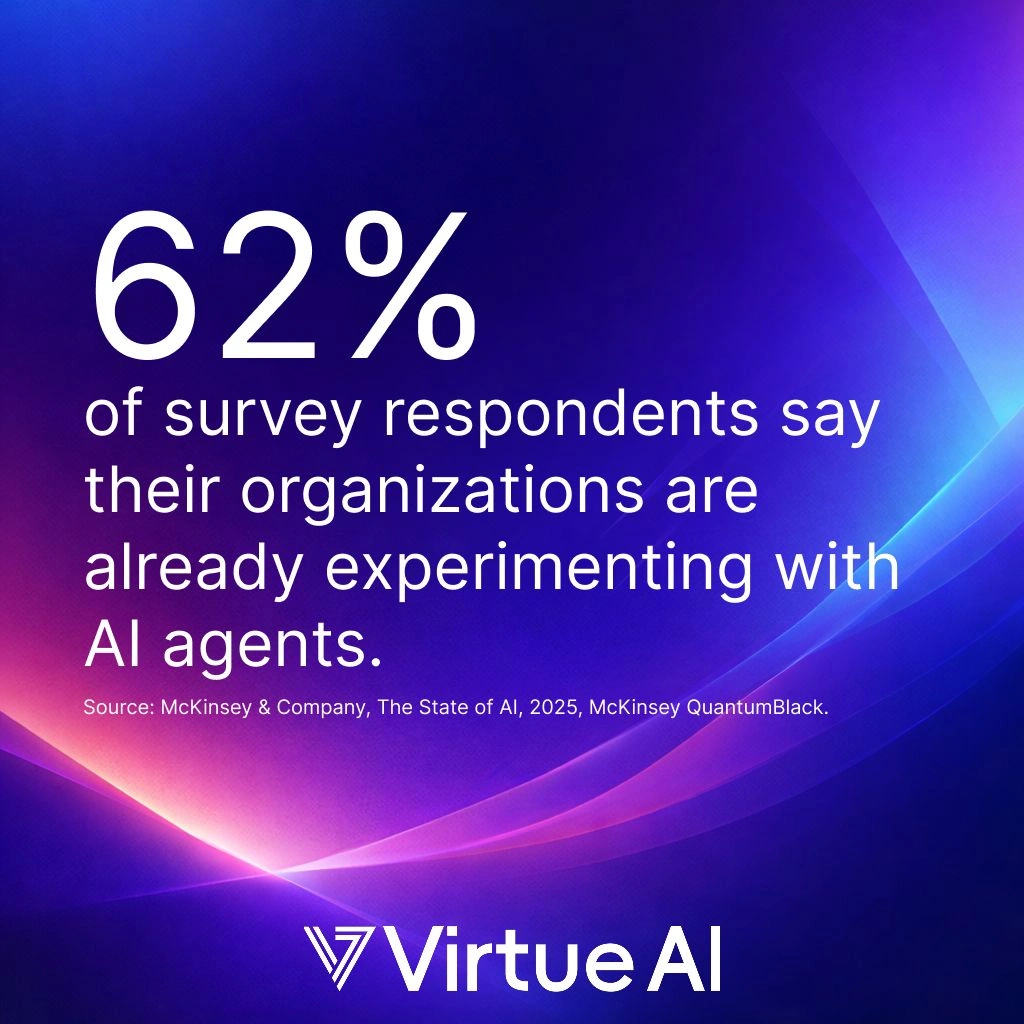
According to a LinkedIn post by Virtue AI based on a study by McKinsey & Company, 62% of organisations are already experimenting with AI agents for workflow orchestration, task prioritisation, and internal copilots.
Cross-Team Collaboration Inside Digital Workplaces:
A lot of companies have CRM platforms such as Salesforce, HubSpot, Zendesk, Freshworks, and Zoho as their primary platform for customer history and retention; AI is going to change this by helping predict what tickets need to be escalated, identifying risks of customers churning, and suggesting responses and follow-ups. Coupled with AI analytics tools like Mixpanel, Amplitude, Tableau, and Power BI, ecommerce operations managers understand not just what happened, but why, and how they will know what to do next.
Generative AI for Internal Use:
Generative AI is useful for more than just creatives. It can streamline producing standard operating procedures (SOPs), summarise weekly metrics, explain raw data in ways that non-data analysts can understand, and help teams document processes quickly. The result of this functionality creates more resilient operations in a lean team environment.
AI Automation for Ecommerce Workflows:
End-to-End Process Automation:
AI-based workflow automation is ideal if it incorporates an entire process automation workflow from beginning to end. For example, early detection of order exceptions, early detection of high-risk shipments, and automated triggering of customer updates are all ways ecommerce automations show up every day. Fewer escalations, less manual monitoring, and faster corrective action will be achieved through ecommerce automation.
Smarter exception handling and quality control:
You cannot expect to automate everything; the best way to go about AI for ecommerce is to automate predictable work. This will free humans so they can deal more with edge cases. AI is able to identify abnormal events, such as unusual return rates, repetitive delivery issues and detect sudden drops in conversion on a product page. Teams will then do the investigation and determine the causes of the incidents.
AI-Driven Commerce and the Future of Ecommerce Teams
With AI ecommerce, teams have continual insight rather than being dependent upon periodic reporting. This trend is especially pronounced in online retail businesses, as they now compete for customers based on speed, experience, and operational efficiency.
It will also be evident within fashion technology, as fashion companies that can efficiently manage a rapidly changing demand for their products have a much better chance of outperforming their competition in planning for inventory, content, and advertising.
In the future, the winning teams will not be the ones that have the most technology or systems available; rather, they will be the teams with the cleanest, most effective workflows, the greatest data integrity, and the clearest lines of ownership.
Conclusion: Building Smarter Ecommerce Operations With AI
The role of AI in ecommerce operations is on the rise. Teams are increasingly using AI to automate repetitive tasks, provide improved visibility into workflows, and make faster, more thorough, data-driven decisions; hence, AI is giving ecommerce teams better abilities to manage complexity as they grow their businesses.
Rather than replacing the role of human expertise, AI is complementing this by allowing teams to focus more on areas like strategy, coordination and problem-solving, than the execution of routine activities. Based on Nethority’s experience working with growing ecommerce operations, the most successful AI implementations prioritise clean data, clear ownership across teams, and gradual automation of high-impact workflows, creating a sustainable foundation for long-term growth
FAQs:
AI is improving day-to-day workflows by streamlining workflows, detecting problems before they develop into larger issues, and allowing ecommerce teams to spend most of their time making decisions rather than doing manual tasks.
Ecommerce team functions that benefit most from AI systems include operations, inventory planning, customer service, marketing operations, and data analytics. All these areas see an increase in efficiency, accuracy, and alignment amongst different departments.
Yes, AI can reduce operational costs associated with ecommerce businesses as it minimises manual workload, catches inventory errors, reduces lost revenue from returns, and increases productivity without increasing headcount.
AI helps ecommerce teams make better decisions by analysing large volumes of operational, customer, and inventory data in real time. This is especially valuable in environments with multiple SKUs, channels, and fulfillment partners, where manual analysis is too slow to prevent revenue loss or operational bottlenecks.
Yes. AI is very appropriate for small and mid-sized ecommerce to automate daily operational tasks, allowing them to reduce the amount of manual work and still efficiently grow their business without investing in complicated, costly infrastructure.