2025 eCommerce SEO Trends Based on Recent Industry Insights
14th August 2025 / in Ecommerce / by Ruturaj Kohok
Picture this: you’ve built a solid e-commerce business, invested countless hours perfecting your products, and created a website you’re proud of.
But the ground is shifting beneath your feet faster than ever before.
We’re talking serious numbers here. Check it out:
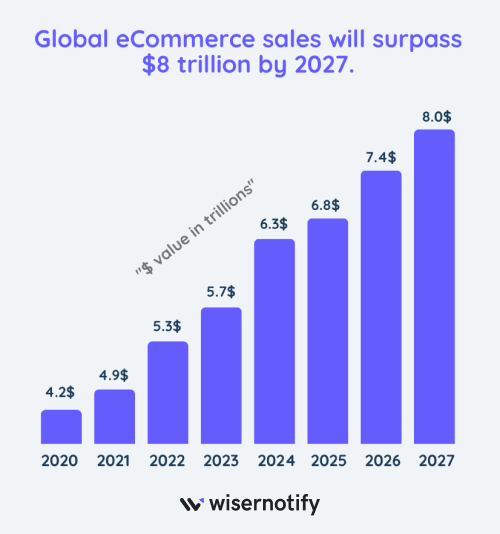
Source: Wisernotify
Global retail e-commerce sales crossed $6.8 trillion in 2024 and are heading straight for $8 trillion by 2027. That’s MASSIVE growth, but here’s the kicker – the way customers find and buy products online is changing at breakneck speed.
But wait, did you know that your customers aren’t even starting their shopping journeys on Google anymore?
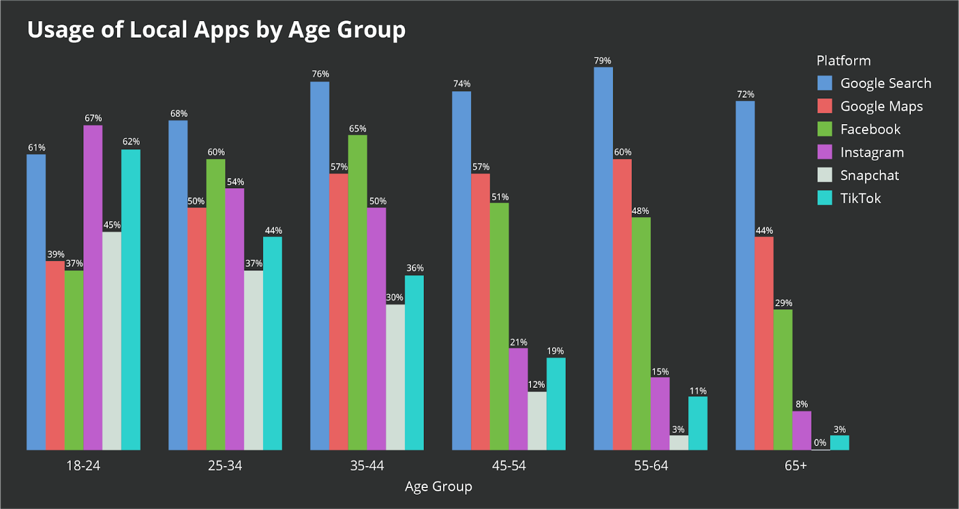
Source: Forbes
67% of young users aged 18-24 prefer to begin their searches on Instagram and 62% on TikTok, showing us that Gen Z heads to social platforms before traditional search engines.
So what does this mean for your business? Simple: if you’re still playing by the old SEO rules, you’re already falling behind.
We understand how overwhelming this can feel. That’s exactly why we’ve put together the biggest e-commerce trends shaping 2025, along with actionable strategies you can implement right away.
Let’s get started!
Top trends in e-commerce SEO: AI and automation
AI isn’t just knocking on the door anymore; it’s already there! And honestly, that’s exactly what your e-commerce business needs right now.
#1 Generative AI and content creation
We get it: creating quality content at scale feels impossible sometimes.
You’ve got hundreds, maybe thousands, of products to describe, blog posts to write, and social media content that needs to stay on-brand. It’s exhausting!
What can you actually do with AI for content creation?
You should go for SEO-optimised product descriptions, blog posts and landing pages targeting your most important keywords, and social media content that keeps your brand voice consistent across platforms.
A significant number of marketers now use AI specifically for social content creation as well as SEO analysis. This isn’t about working harder; it’s about working smarter.
#2 AI-powered product recommendations
Remember when personalisation was just a fancy word around the marketing scene? Those days are long gone.
Source: Bloomreach
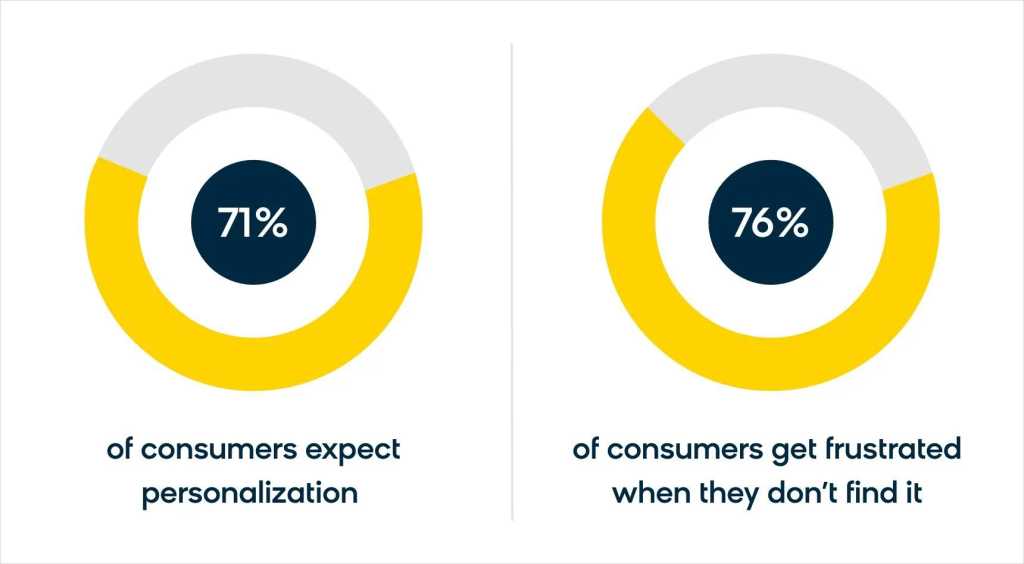
Today, over 70% of shoppers expect AI-driven personalised experiences during their online shopping journey, and 76% get frustrated if they don’t get it.
We’re talking about sophisticated recommendation engines that analyse browsing history, past purchases, and even how long someone stares at a particular product.
Here’s why this matters for your bottom line: Well-implemented AI recommendation systems can increase sales significantly. Plus, shoppers are more likely to return to websites that recommend relevant products.
Think about Netflix – you keep coming back because they know exactly what you want to watch next, right? If you keep up with e-commerce trends, your store can work the same way.
#3 Chatbots and conversational commerce
Let’s be honest: nobody likes waiting for customer service. And your customers? They’re even less patient than you think.
Source: Cedcoss
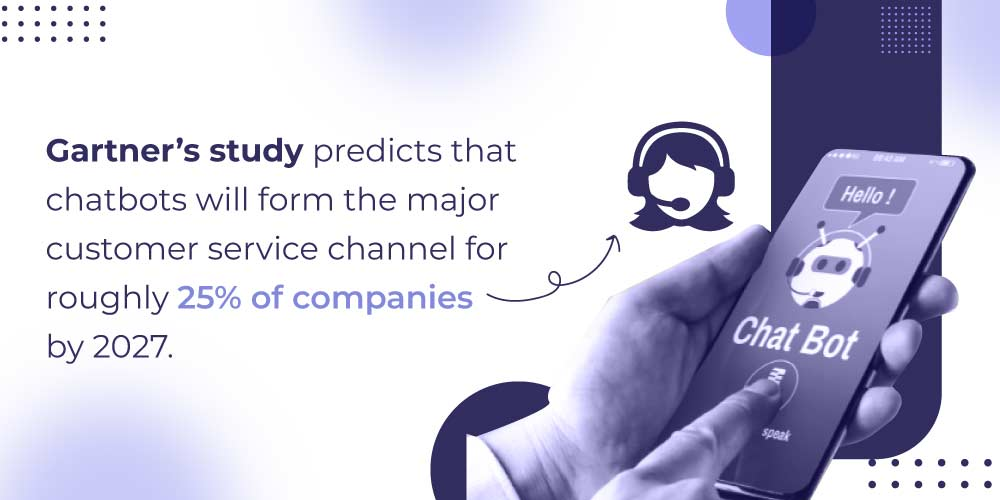
Gartner predicts chatbots will become a primary customer service channel by 2027, and frankly, we’re not surprised.
Source: Adam Connell
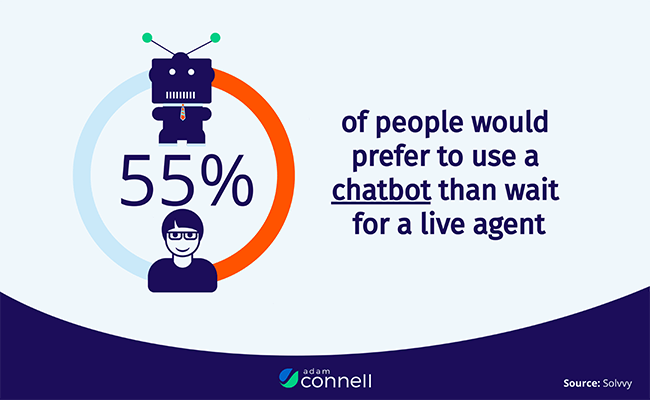
Here’s the real kicker: 55% of consumers would rather interact with a chatbot than wait for a human agent! That’s how impatient we’ve all become.
But chatbots aren’t just for answering “Where’s my order?” anymore. They’re helping customers discover products, handling transactions, and collecting valuable data about what your customers actually want.
You can also implement AI chatbots to help you reduce your manual effort in servicing your customers, and trust us, thanks to e-commerce trends in 2025, they’re more than capable of handling complex queries.
Search trends in e-commerce: from Google to GEO
Ranking on the first page of Google just doesn’t cut it anymore.
With the rise of e-commerce, the search landscape is experiencing a seismic shift right before our eyes.
Google’s dominance isn’t quite what it used to be, and AI-powered tools are redefining how your customers discover products online.
Traditional SEO tactics? They need some serious updating to stay effective.
What is Generative Engine Optimisation (GEO)?
Think of GEO as SEO’s smarter, more sophisticated cousin. It is one of the most up-and-coming e-commerce industry trends.
While traditional SEO focuses on ranking in those familiar blue links we all know, GEO is all about optimising your content specifically for AI systems like Google’s SGE (Search Generative Experience) and Bing’s AI-powered results.
So what makes GEO different?
The core principles include clear, concise answers to specific questions your customers are asking, factual, authoritative information from credible sources, and structured data that AI systems can easily interpret and reference.
GEO is one of the most progressive e-commerce search trends that you should implement right away.
Here’s the reality check:
If you’re still focusing solely on traditional SEO metrics, you might find yourself becoming increasingly invisible as AI-generated answers become the main way searchers get their information.
You should keep up with the latest e-commerce trends to stay updated with the advancements in GEO, as it can benefit your business greatly.
Structured data and schema markup for AI visibility:
Want to speak the language that AI systems understand? That’s where structured data comes in.
Schema markup has become one of the absolutely essential e-commerce trends for better visibility in AI search results.
When you implement it properly, you’re essentially helping AI systems interpret your product information accurately.
Products with proper schema markup have a significantly higher chance of being featured in AI overviews and shopping recommendations.
You should prioritise product-specific attributes like price, availability, and ratings, rich content elements including videos, images, and FAQs, and entity relationships that connect your products to categories and brands.
Getting cited in AI Overviews and ChatGPT search:
Being cited in AI-generated overviews? That’s the most valuable thing in modern search right now.
If you want to increase your chances of being referenced by AI, focus on genuinely helpful content that directly answers common customer questions. AI systems prioritise sources that provide clear, authoritative information.
Other than that, to keep up with the current trends in e-commerce, ensure to build topical authority through covering subjects relevant to your products. AI systems favour sources with demonstrated expertise in specific areas.
Optimise for featured snippets as well, since many AI systems pull information from these existing search features when generating responses.
Remember, earning AI citations requires a commitment to quality content that truly serves your customers’ needs rather than just trying to manipulate search algorithms.
Top e-commerce SEO trends to watch in 2025:
So we’ve covered AI and search evolution, but that’s just the beginning! Your customers are shopping and searching differently, and expecting more than ever before.
Let’s check out the latest e-commerce trends right now.
Voice search optimisation:
The top-most emerging trend in e-business is voice search.
Source: Mordor Intelligence
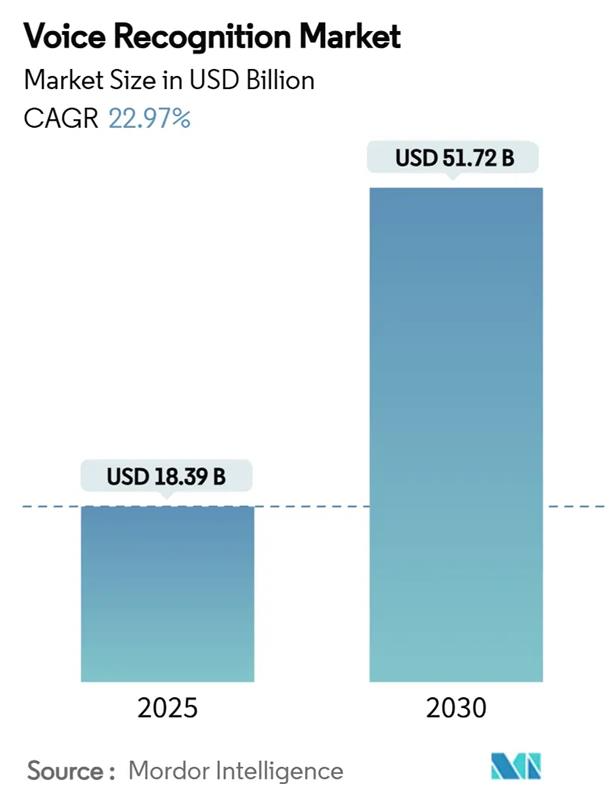
The voice recognition market is projected to reach $51.72 billion by 2030, from $18.39 billion in 2025.
With 8.4 billion voice-assisted digital assistants in use worldwide, you simply can’t ignore this anymore.
Think about it: when you ask Siri or Google something, you don’t type “best pizza restaurant.” You say, “Where’s the best pizza place near me?”
This shift to conversational queries is one of the top e-commerce search trends in 2025.
For voice search optimisation, create conversational, question-based content that sounds natural when spoken, target long-tail keywords that match how people actually talk, build FAQ-style content that directly answers common questions, and implement speakable schema markup to boost your voice search visibility.
Visual and video SEO for social platforms:
We live in a visual world. Check this out:

Source: Demand Sage
80% of internet users worldwide watch online videos monthly.
But here’s what’s really interesting:
Source: HubSpot
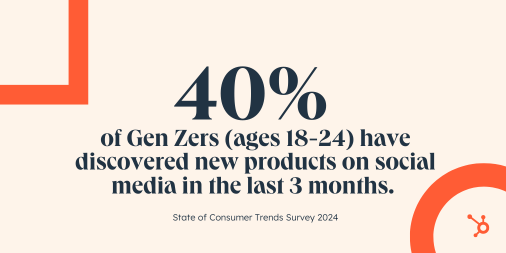
40% of Gen Z customers discovered products on social media in the past three months. Social platforms are becoming search engines!
To keep up with this latest e-commerce trend, your video SEO strategy should include optimising video titles and descriptions with targeted keywords, creating compelling thumbnails that make people want to click, adding closed captions for better accessibility and searchability, and including clear calls-to-action early in videos and descriptions.
Mobile-first indexing and performance:
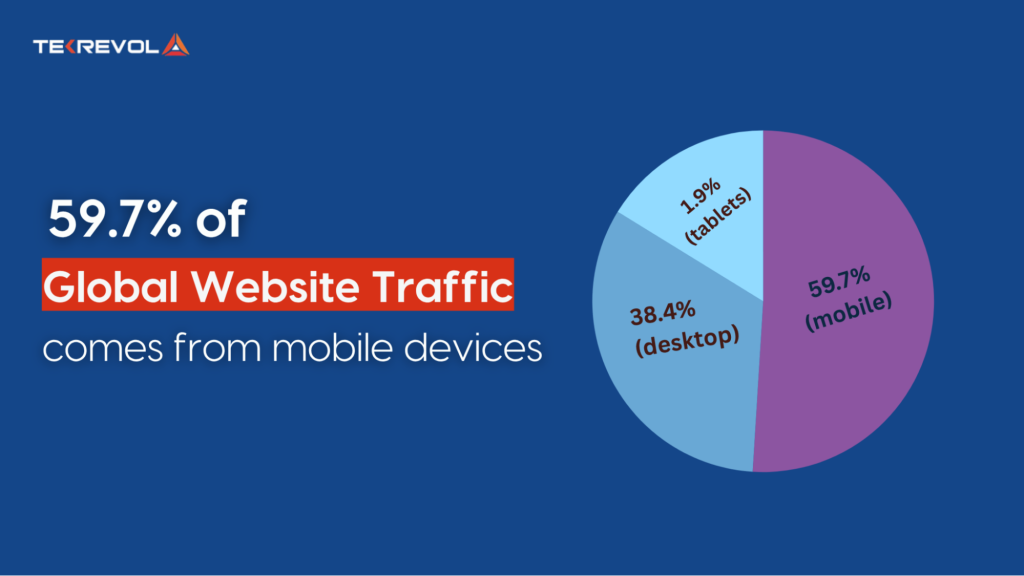
Here’s something that might surprise you: Google now uses the mobile version of your site as the PRIMARY basis for indexing and ranking.
Source: Tekrevol
This is because 59.7% of all web traffic globally comes from mobile devices.
Your mobile optimisation priorities should be ensuring your mobile and desktop content match perfectly, optimising Core Web Vitals (LCP, INP, and CLS), getting load times under 2.5 seconds, and using responsive design with proper viewport settings.
The impact of e-commerce on business models is tremendous; everyone is shifting to a digital model to keep up with the latest e-commerce trends.
Personalisation and dynamic content:
Remember when personalisation felt special? Now it’s expected! Customers demand tailored experiences across ALL touchpoints.
Check this out:
Source: Wisernotify
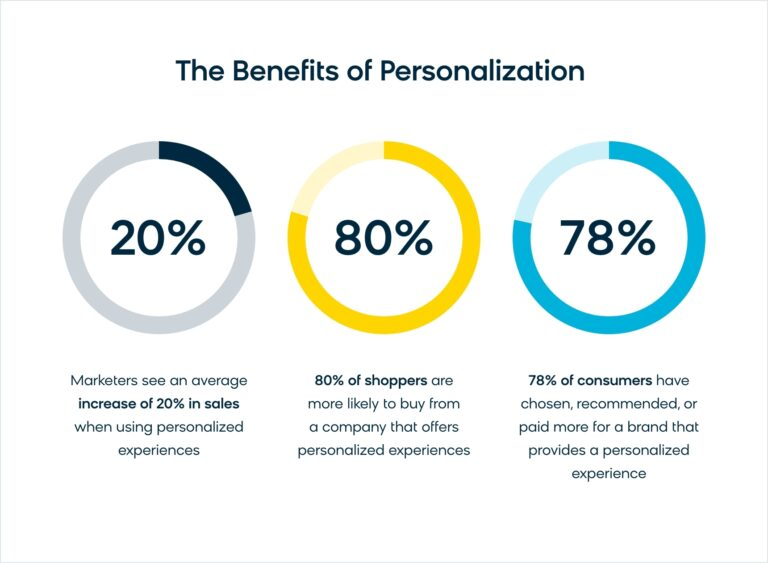
Personalised product recommendations can increase conversion rates by up to 20%, with 80% of shoppers more likely to buy from a company that provides personalisation in their shopping experience.
Other than that, 78% of consumers are willing to pay more for a brand that offers them a more personalised experience.
These stats alone make it almost mandatory for e-commerce businesses to implement personalisation right away to stay on top of the current trends in e-commerce.
Effective personalisation strategies include dynamic content that adapts to user behaviour and demographics, AI-powered chatbots providing instant and personalised support, loyalty programs that collect first-party data for better personalisation, and custom storefronts reflecting individual preferences and past purchases.
Feed-based SEO and product data optimisation
Your product feed is the digital backbone of your online store, and optimising it is crucial for visibility across multiple channels.
Poor feed quality equals missed opportunities and wasted ad spend, and nobody wants that!
With the rise of e-commerce, you should focus on your product feed optimisation.
Write accurate and detailed product titles and descriptions, complete product attributes, including brand, GTIN, MPN, etc., use high-quality images that meet platform requirements, and get regular updates reflecting inventory and pricing changes.
Local and omnichannel SEO strategies
Don’t underestimate local SEO! Searches with local intent typically come from users ready to purchase.
Source: Loopex Digital
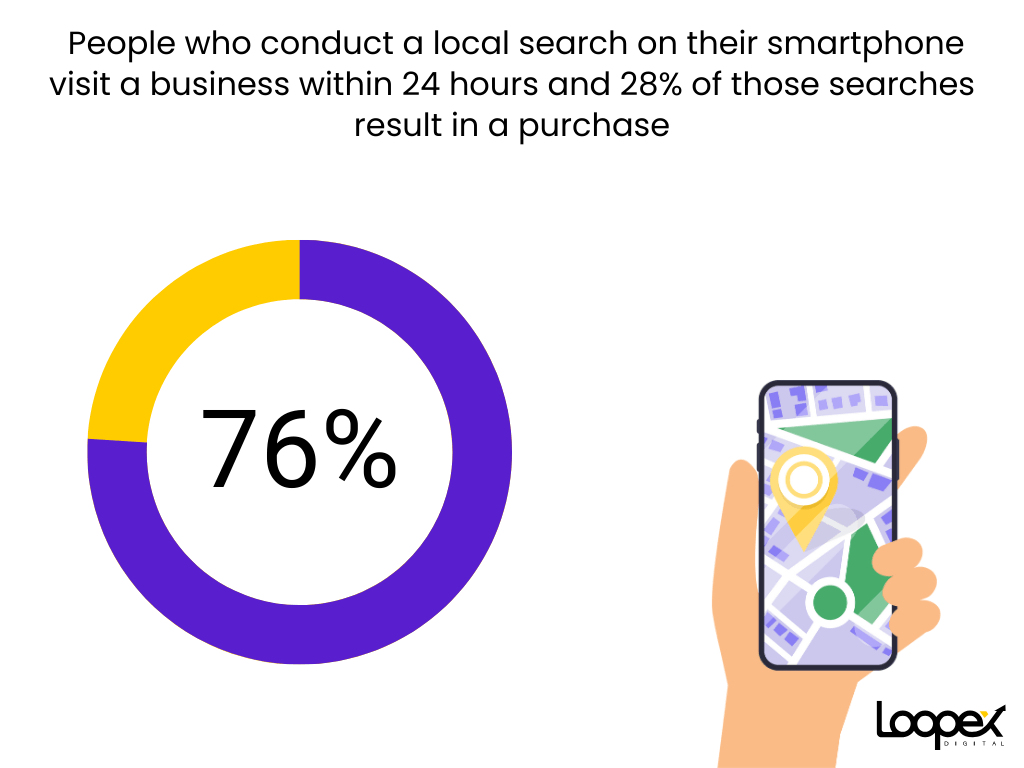
Plus, 76% of consumers used search engines to find local businesses and visited them within 24 hours, and 28% of those resulted in a purchase. That’s a huge opportunity.
Local and omnichannel strategies are emerging trends in e-business, and you should tap into them as soon as possible!
Your local and omnichannel strategies should include creating and maintaining a Google Business Profile, using local keywords in your titles and descriptions, showing in-store availability on your website, and offering buy-online-pickup-in-store (BOPIS) options.
Future-proofing your e-commerce SEO strategy
We know what it’s like when you’ve spent months building your SEO strategy, only to watch your traffic disappear overnight because of an algorithm update. It’s frustrating, and honestly, it’s becoming way too common.
So what can you do about it? Let’s check out some strategies to bulletproof your business.
#1 Diversify traffic sources beyond Google
Relying solely on Google for traffic? That’s not going to work per e-commerce trends in 2025.
Smart businesses are now building multiple “doors” into their digital presence, such as direct channels like push notifications and email newsletters, social platforms that drive significant referral traffic, and mobile apps offering exclusive content access.
Think of it this way, if one door closes, you’ve got several others wide open!
#2 Focus on mid-funnel and bottom-funnel content
Here’s something interesting we’ve noticed: while AI takes over those basic “what is” searches, there’s still a HUGE opportunity in content that helps people make buying decisions.
Mid-funnel content gives you the best balance between traffic potential and conversion power. Bottom-funnel content? That’s your closer, which gives prospects the final push they need to convert.
Focus on comparison pages, buying guides, and product-specific content that addresses users who are closer to making purchase decisions. These people are ready to buy; they just need you to guide them!
This is an important strategy to drive traffic to your website, as per the up-and-coming e-commerce trends.
#3 Create interactive tools and calculators
Want to know a secret? Interactive content generates twice the engagement of static content.
We’re talking about ROI calculators, quizzes, product configurators, basically anything that gets your visitors actively involved.
These tools don’t just improve dwell time and reduce bounce rates; they’re also powerful lead generation mechanisms.
Calculators provide personalised information, making users feel the experience is custom-tailored to their needs. And who doesn’t love feeling special, right?
#4 Monitor ROI and adapt to algorithm changes
Let’s be honest, SEO isn’t a quick fix. It’s a long-term investment that requires patience, constant monitoring, and staying updated with e-commerce industry trends. In doing so, you need to keep up with the trends in e-commerce that influence factors driving traffic.
You can track performance and ROI. But here’s the thing: meaningful results typically emerge after six months. That requires patience!
Regular analysis helps you identify what’s working and what’s not, so you can redirect resources toward more effective approaches.
#5 Collaborate across SEO, content, and paid teams
Here’s what successful businesses do differently: they don’t let their SEO strategy operate in isolation.
When your SEO, content, and paid teams work together, magic happens.
You create more cohesive customer journeys, share insights across channels, and build resilient marketing ecosystems that can weather unexpected changes.
This collaborative approach is your insurance policy against algorithm fluctuations!
Remember, the goal isn’t just to survive the trends in e-commerce – it’s to thrive despite them.
Final thoughts: Keeping up with SEO trends in e-commerce businesses
E-commerce SEO has officially entered a whole new world where AI, multiple search channels, and customer experience rule the game.
The old-school SEO playbook? It’s not going to cut it anymore; you need to keep up with e-commerce trends to drive more audience and revenue to your business.
The e-commerce world will keep changing faster than we can keep up with. But the businesses that start implementing these strategies NOW are the ones that’ll be winning big while their competitors scramble to catch up.
We believe the most successful e-commerce businesses don’t see SEO as just another marketing tactic – they see it as part of their entire digital strategy.
Ready to get started?
Get in touch with us for expert e-commerce SEO services!
FAQs:
AI is revolutionising e-commerce SEO by powering content creation, product recommendations, and chatbots. It’s also reshaping search with AI-generated answers, making traditional SEO tactics less effective and introducing new concepts like Generative Engine Optimisation (GEO).
Personalisation has become essential in e-commerce SEO. It can increase conversion rates and average order value significantly. Effective strategies include dynamic content, AI-powered chatbots, loyalty programs, and custom storefronts reflecting individual preferences.
To future-proof SEO strategies, e-commerce businesses should diversify traffic sources beyond Google, focus on mid-funnel and bottom-funnel content, create interactive tools and calculators, monitor ROI and adapt to algorithm changes, and foster collaboration across SEO, content, and paid teams.
Voice search optimisation is crucial as the voice recognition market is projected to reach $51.72 billion by 2030. With over 20% of mobile searches being voice-based, businesses need to focus on conversational content and long-tail keywords to remain competitive.
To adapt to mobile-first indexing, e-commerce businesses should ensure content parity between mobile and desktop versions, optimise Core Web Vitals, reduce load times to under 2.5 seconds, and implement responsive design with proper viewport settings.