
AI Chatbots in Ecommerce: How They Improve Sales and Customer Support
9th January 2026 / in Ecommerce / by Ruturaj Kohok
- Reading time: 8 mins 05 Sec
Have you ever been on an e-commerce website and started typing a question, only to have a chat window pop up asking if you were looking for help or needed assistance? That chat window is probably an AI chatbot for ecommerce, and it is fundamentally altering the way that businesses engage with customers.
Source: Tidio
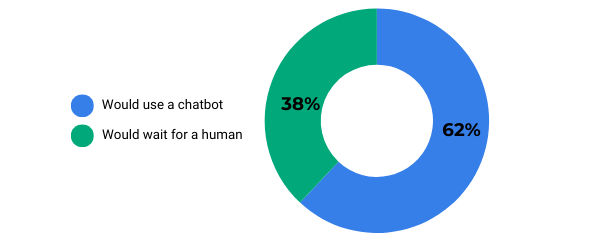
62% of users would rather have their queries solved by a chatbot rather than wait for a human agent. So, if you are an ecommerce business owner, you must understand how these AI customer support chatbots operate and affect the sales and customer support functions of your business.
In this blog, we will discuss how chatbots function in practice, identify several common types of chatbots available, and provide insight into implementing chatbots on ecommerce websites across all types of platforms.
What Is an AI Chatbot in Ecommerce?
The AI chatbot for ecommerce acts as a digital assistant who enhances the shopping experience of the consumer by providing simulated exchanges with the merchant during all phases of the purchase process. An AI customer support chatbot creates a personalised shopping experience for each shopper by allowing the consumer to interact with the merchant through a series of automated exchanges, aiding them through the shopping experience, from product selection to follow-up after they make their purchase.
Read more: The Impact of AI and Personalisation on D2C Success
How AI Chatbots Work in Ecommerce
AI chatbots in digital commerce use a number of advanced technologies that work together to provide the user with solutions to their queries. The base of it all is NLP (Natural Language Processing), which understands the foundational intent of the query and analyses its structure to interpret the customer message. Once the intent is recognised, it extracts relevant entities like customer details, product names, dates, and more.
What stands out about these customer support chatbots is how they maintain context by tracking previous messages to ensure logical conversations. It uses dialogue management to maintain the conversation and decide the next action.
Many modern AI chatbots utilise machine learning algorithms to further improve the quality of their responses and the overall conversation, ensuring greater customer engagement. This process ensures that the chatbot is continuously learning how to adapt to various scenarios and offer relevant information.
These AI-based automated support systems can analyse the emotion behind words and understand the tone of the message, making the interaction more personalised. Such personalisation in ecommerce, in turn, creates shopping experiences that feel significantly
human.
Read more: AI-Driven Personalization: The Key to Better Online Shopping Experiences
AI Chatbots vs Rule-Based Chatbots in Ecommerce:
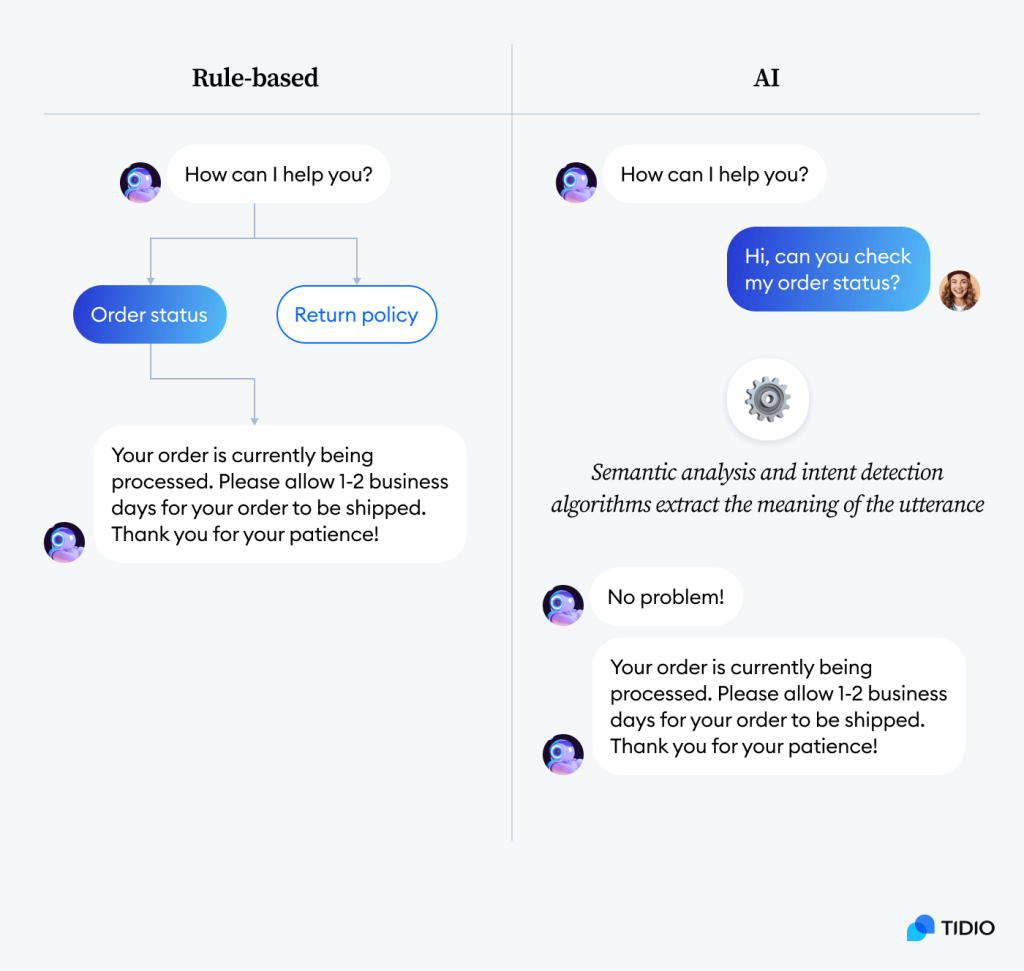
Rule-based chatbots operate on decision trees, which are basically pre-determined scripts that it follows in its interactions. It limits the chatbot support responses to certain phrases and keywords, rather than analysing the context and intent behind them. The users are guided through a predecided series of options, which does not seem natural in today’s AI world. These rule-based bots generally follow the “if-then” logic, making them rigid and inflexible.
AI chatbots for ecommerce, on the other hand, implement machine learning and natural language processing to identify the intent behind each customer query. It can handle complex dialogues in real time and generate dynamic responses that are conversational in nature. It learns from each interaction, thereby improving its accuracy over time.
Source: Tidio
Because of these differences, AI chatbots are considered to be significantly more adaptable and flexible, and are increasingly preferred by digital marketing specialists for ecommerce businesses.
Types of Ecommerce Chatbots?
Rule-Based Ecommerce Chatbots:
Rule-based chatbots are based on pre-existing scripts and decision trees, and only work on predetermined systems that operate from an “if/then” format. This chatbot support is essentially a manually programmed bot that will give you a set of answers based on your inquiry, without any artificial intelligence.
Rule-based chatbots are useful for repetitive and basic tasks, such as answering common questions, tracking orders, and explaining return policies. In the case of small businesses, rule-based chatbots provide a cost-effective way to automate these types of jobs, like appointment scheduling or answering to common customer inquiries.
AI-Powered Ecommerce Chatbots:
AI chatbots for ecommerce are much more advanced than rule-based chatbots; they can understand customers’ intent and context, and hold human-like conversations, because they utilise natural language processing (NLP). Unlike rule-based chatbots, AI-powered chatbots do not rely solely on keyword matching; they analyse the substance, intent and sentiment of the customer’s question and give contextually relevant responses.
The strength of AI chatbots, however, is in their machine learning capabilities, which allow them to learn from previous conversations and improve their ability to respond appropriately to complex, multi-turn conversations, even when the questions are formed in unexpected ways.
Read more: The Future of Machine Learning: Trends and Insights
Hybrid Ecommerce Chatbots:
Hybrid chatbots are a combination of rule-based and AI chatbots in digital commerce. By using both rule-based logic to carry out simple tasks and AI for complex situations, the combination of these two types of technology can provide you with the stability associated with traditional, rule-based systems while being flexible enough to deliver AI-generated conversations.
Hybrid chatbots are extremely advantageous because they create a structured system for customers to ask questions, while still allowing unexpected questions to be efficiently answered using AI. Furthermore, hybrid chatbots provide an immediate pathway to human agents for complicated customer issues.
Voice Chatbots for Ecommerce:
Voice chatbots are the newest type of chatbots in conversational commerce that enable users to search for products, place orders, and track shipments all by talking to a voice-assisted AI system.
Voice chatbot support is capable of recognising spoken commands, interpreting user intent and responding using natural language processing and machine learning techniques. In addition to understanding straightforward commands, voice commerce technologies now have sophisticated methods to understand customer intent and personalise responses based on preferences when shopping.
The technologies behind voice chatbots have greatly improved by integrating generative AI, through which voice assistants can remember previous conversations, offer personalised product recommendations and hold open-ended discussions about products.
How AI Chatbots Improve Ecommerce Customer Support?
24/7 Customer Support With AI Chatbots:
Many customers use customer support chatbots during non-office hours when they typically have an issue that needs immediate attention. A number of customers list 24*7 availability as one of the key signs of great customer service. Round-the-clock availability enables companies to be responsive to customers across the globe and cater to various time zones.
Customers appreciate getting help right away, which means there is no waiting time between calling for help and receiving the response needed. Because of this, AI chatbots for ecommerce provide significant time savings and a better customer experience for users.
Handling FAQs and Repetitive Customer Queries:
Many times, customers use chatbot support for repetitive inquiries, which can be predicted based on trends in the types of questions asked. Questions regarding shipping policies, return procedures, product availability, and payment methods tend to repeat. This makes the use of AI in customer support chatbots the best way to manage these repetitive inquiries.
Reducing Customer Support Costs Using AI Chatbots:
Integrating chatbots in ecommerce marketing channels can significantly reduce costs associated with providing manual support to users to solve their queries.

Source: LocaliQ
It is estimated that businesses that utilise chatbots can save an average of $300,000 per year. This can be invested elsewhere in the company that can generate higher results.
Seamless Handoff From Chatbots to Human Agents:
A smooth transition means that when a customer is transferred to a human support agent, the entire chat history and customer data are transferred to the agent. This will allow the agent to provide assistance with the complete context of the conversation without the customer having to repeat the information they provided earlier.
How AI Chatbots Increase Ecommerce Sales?
Personalised Product Recommendations Using AI Chatbots:
Automated support systems use the information available about users, for example browsing, social media and purchase patterns, to provide them with personalised product recommendations that fit their tastes. This level of personalisation in ecommerce adds to the user’s shopping experience.
Upselling and Cross-Selling With Ecommerce Chatbots:
Chatbots in digital commerce can identify the best opportunity to offer customers a premium product or complementary product. When a customer interacts with an AI chatbot, their Average Order Value increases.
Abandoned Cart Recovery Using AI Chatbots:
AI Chatbots can identify when consumers are hesitant to purchase, and intervene with a limited time offer, promotional discounts, free shipping, alternative products or suggestions. These proactive interventions help ecommerce business owners recover lost sales.
Personalised Promotions and Discount Alerts:
Chatbots are effective at delivering customers personalised promotions based on their shopping behaviour. AI chatbots for ecommerce automatically apply the most relevant promotions to customers without requiring them to search for coupon codes or discounts.
Source: Ecommerce Bonsai
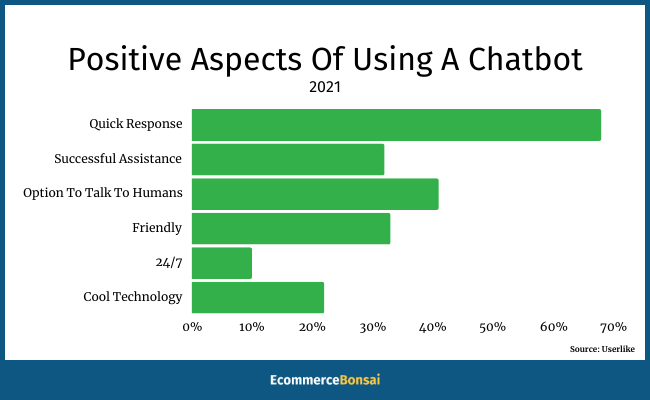
These positive aspects of using AI chatbots in ecommerce have become more than just a cool technology, as considered by around 20% people; it is a strategy to increase sales and drive sustainable commerce growth.
Read more: Factors Influencing Consumer Behaviour: Strategies for E-commerce Success
Where Ecommerce Chatbots Are Used Most Effectively
Ecommerce Websites (Shopify, Magento, WooCommerce):
Ecommerce platforms such as Shopify, Magento, and WooCommerce all use AI customer support chatbots to assist users while they shop. The chatbots integrated with Shopify connect with the customer’s order history and product listing information, allowing for personalised recommendations and automated product availability notifications based on the customer’s individual orders. Therefore, when there is a question about product availability, the chatbot will provide current product availability instead of using generic responses.
The flexible architecture of Magento allows for great flexibility in coordinating chatbot integration, utilising customer segmentation data and managing complex product configurations across stores. This flexibility is very important for companies that have multiple stores or multiple variations of products in their store.
With WooCommerce, users can integrate chatbot interactions into product pages to allow for real-time contextual assistance immediately, allowing customers to complete their purchases more easily. The chatbots can answer any questions customers may have regarding size, compatibility, or delivery options as customers make decisions about what to buy.
Read more: Why E-Commerce Stores Fail Without a Platform Strategy?
Messaging Platforms Like WhatsApp and Facebook Messenger:
Over 2 billion people use WhatsApp every month for conversations. Businesses also use the WhatsApp Business API to automate messages, track orders, and create custom marketing campaigns
Businesses can use Facebook Messenger bots to find customers through Facebook Shop and groups. These interactions are easy for customers to continue about products they have seen, as social commerce & Facebook are integrated.
In regions where mobile commerce is common, people are more likely to use messaging platforms than anywhere else. People in the United States and the United Kingdom have sent a message to a company in the last three months not only for customer service, but for actual purchases.
Read more: Why Every E-commerce Brand Needs a Mobile-First Strategy?
Mobile Apps and Live Chat Widgets:
The majority of customers who use live chat widgets on ecommerce websites rate their overall satisfaction highly. An embedded automated support system can greet a customer upon arrival to the site, guide that customer through the purchasing process, and intervene when the customer shows signs of abandoning the shopping cart.
Mobile app integration makes it even easier for customers to purchase, track delivery, and verify loyalty points without having to leave the application. As a result, customers remain within the ecosystem of businesses, and it’s crucial for customer retention.
Ecommerce Chatbots Across Global Markets:
Businesses must understand that regional differences in language and culture have more impact on their company than they might think. Technology is here to help businesses engage with their local customers in their language through AI chatbots that now support numerous regional languages.
These types of chatbots are particularly helpful in regions with multiple languages, like India or Southeast Asia. Also, a chatbot that works well for customers in New York may require significant changes to meet the needs of customers in Mumbai or Bangkok, because the needs and languages of those specific customers differ from those of US-based customers.
Why AI Chatbots Are Essential for Modern Ecommerce Growth
AI chatbots are no longer only being used as a test in ecommerce; they are now imperative in providing both customer experience and sustainable business success.
Source: The Business Research Company
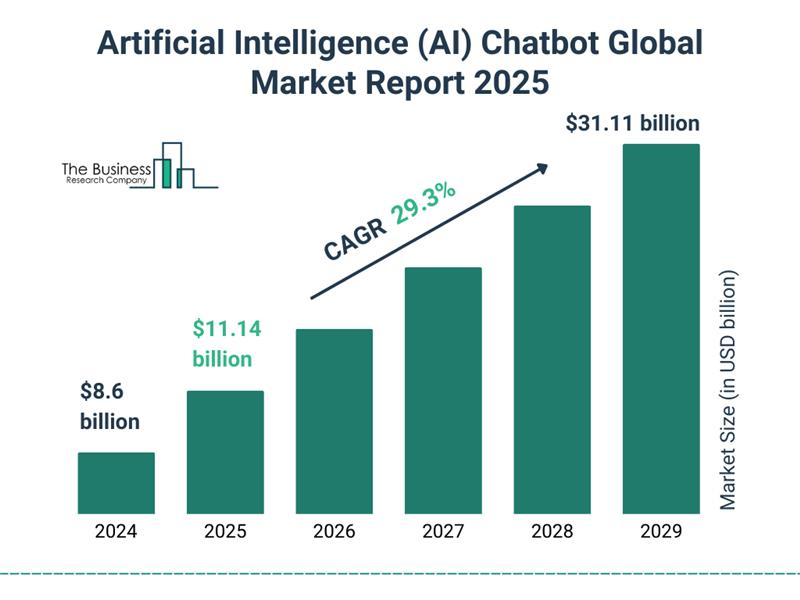
The AI chatbot market size is growing exponentially; it is expected to reach $31.11 billion by 2029. This alone makes it imperative for ecommerce business owners to start implementing chatbots in their marketing channels.
When selecting your chatbot support technology, whether it be rule-based, AI-powered, hybrid, or voice-enabled, the decision should be based on your customer’s preferences on how they interact with your company. Successful strategies take into consideration the efficiency due to automation created by chatbots while simultaneously enhancing the emotional connection of your customers through human-like interactions with the brand.
At Nethority, we understand that chatbots work best as extensions of human customer service rather than as replacements. As expert AI chatbot solution providers, we identify your biggest customer service pain points and most common sales obstacles, and implement chatbots to make the biggest impact.
Now, the question isn’t whether or not this technology will continue to evolve; it is whether you’ll use it strategically to solve real problems for your business and customers.
FAQs:
Ecommerce chatbots are AI-based tools that allow retailers to interact with their customers in real time. They can assist users in providing answers to their questions, while also recommending products.
Conversion rates in online stores can be improved through AI Chatbots by up to 30% by guiding a user’s journey, providing timely answers to questions, delivering personalised recommendations, and reducing customer cart abandonment.
AI Chatbots can serve as effective tools for managing repetitive customer inquiries, so that human agents can manage more complex or emotional customer interactions.
Both small and large brands can benefit from using AI chatbots; however, the impact will be different. Small retailers will see increased efficiency and reduced costs, whereas bigger brands will see the benefits of greater scale, more personalised service delivery, and continuous 24/7 customer service support.
The most common mistakes made by many e-commerce businesses with AI chatbots include not providing sufficient training, providing generic responses, lack of human handoff, over-automation, ignoring analytics, and more.