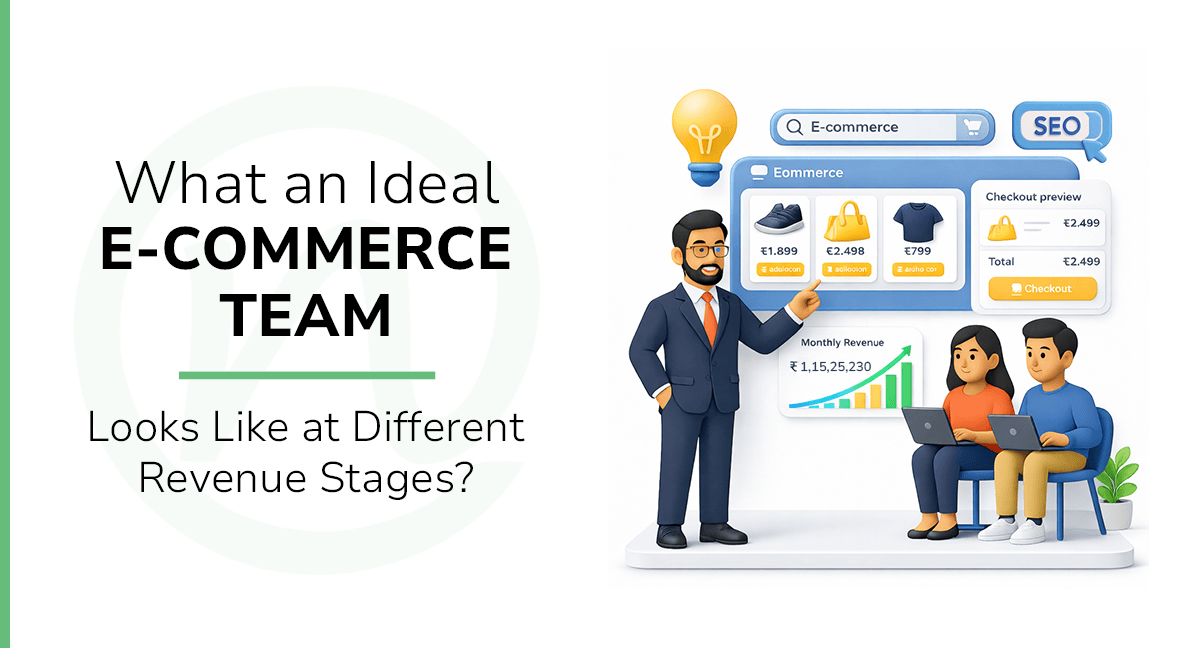
What an Ideal E-commerce Team Structure Looks Like at Different Revenue Stages?
15th January 2026 / in Ecommerce / by Ruturaj Kohok
- Reading time: 9 mins 25 Sec
Most CEOs of ecommerce businesses start with a focus on their products, advertisements, and platform, and they often think that the structure of their team can be addressed later. However, in practice, their e-commerce team structure dictates what the execution speed is, how the customer will experience their products and services, and ultimately how profitable the business will be before it scales.
Different ecommerce businesses can use the same website and tools, but the way in which they structure their teams to complete all the different functions within their business, such as acquisition, optimisation, fulfilment, retention, and reporting decisions, is what matters in determining their long-term success.
Having worked closely with numerous ecommerce teams for businesses at various stages of revenue growth, one recurring pattern can be identified: as businesses expand, their team structures become less aligned with what it takes to generate scalable revenue. When a founder understands how a team must evolve at the different stages of the business, they can make more informed choices on who to hire and what functional processes to implement for higher revenues.
In this blog, we will talk about what an e-commerce team is and how its structure differs between different stages of growth, despite the tools or platforms being used.
Let’s get started!
Understanding the Core Concept of an E-commerce Team Structure:
What Does an E-commerce Team Actually Mean in Practical Terms?
The ecommerce team embodies all aspects of an ecommerce operation, including customer acquisition, conversion optimisation, fulfilment, retention, and data-driven decision making, not just an ecommerce website or an ad campaign in many separate parts of an organisation. Depending upon what stage the business is at, the e-commerce team structure will differ from one organisation to another, although the same ecommerce platforms and tools may be used for those different types of ecommerce operations.
There are three major areas in which the roles of the ecommerce manager evolve as the company grows. As revenue grows, the ecommerce manager will likely split these responsibilities into individual roles with clear outcomes for digital marketing managers, operations managers, and data analysts for each of the three areas of operation.
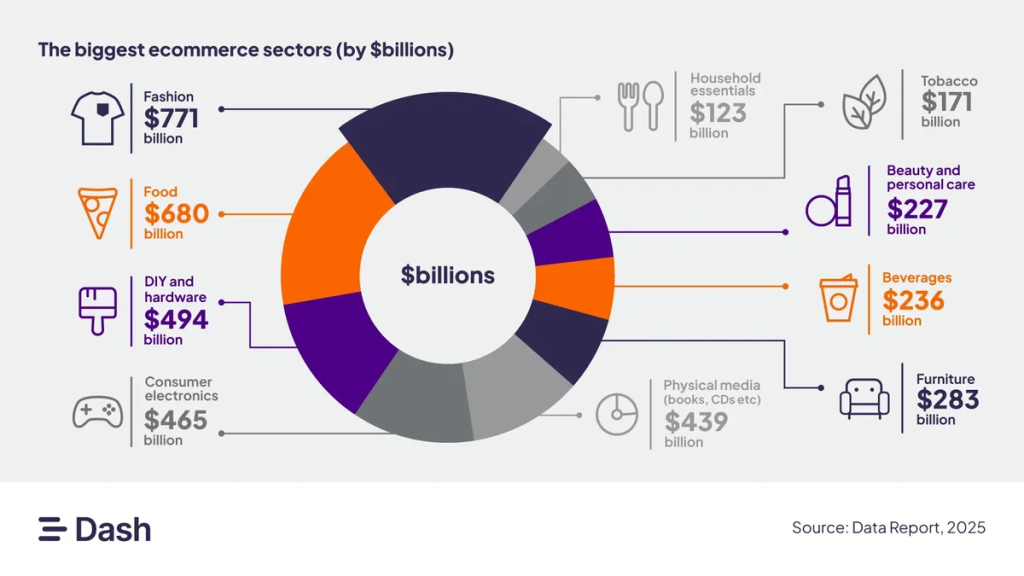
Source: Dash
The structure of an ecommerce team can vary greatly between many different industries: the biggest sector being fashion, food, DIY and hardware, and consumer electronics. Thus, these different sectors approach marketing differently, which influences the way that teams are formed and expanded.
How Ecommerce Team Structure Impacts Revenue, Speed, and Customer Experience?
The structure of the ecommerce marketing team has an impact on the speed of decision-making and consistency of customer service. Poorly structured ecommerce marketing teams create barriers for customers, marketing, and operational processes, taking longer to launch, misreading data, and developing more distinct customer journeys. By creating a clear and aligned process between sales, marketing, and operations, aligned teams are able to reduce friction when working across these departments and increase conversion rates and customer experience.
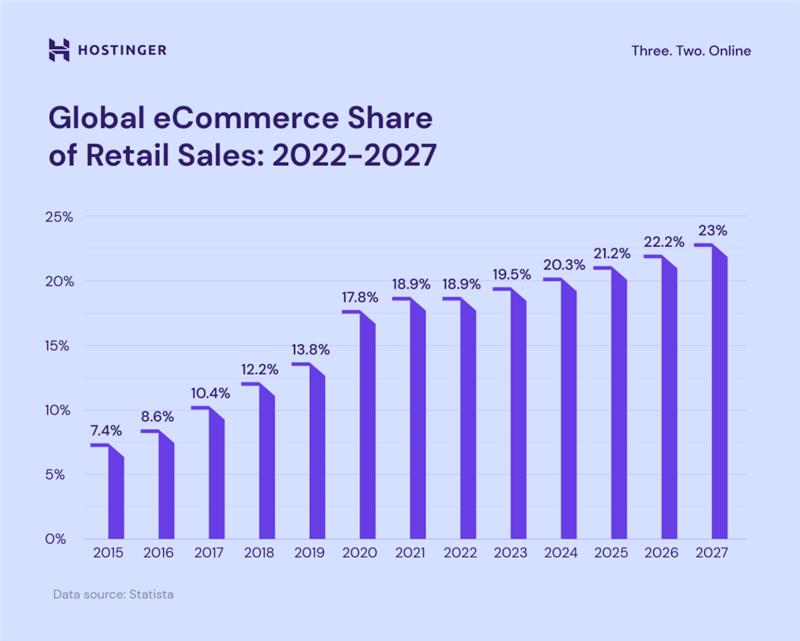
Source: Hostinger
The global ecommerce share is increasing exponentially over the years, making it apparent that brand owners can’t solely rely on informal or founder-led execution. According to Statista’s data published by Hostinger, ecommerce sales could reach 23% of retail sales worldwide in 2027, from just 7.4% in 2015.
Due to larger scales being achieved through consistent growth and increased demand, the expectations placed by consumers on speed of delivery, customer experience, accurate data, and coordination between cross-functional departments are much higher. Therefore, structuring an ecommerce team has become a requirement, rather than a choice, for many companies.
Early-Stage E-commerce Team Structure (₹0–₹50L Annual Revenue):
Team Composition in the Early Stage E-commerce Business:
Ecommerce teams are generally small during the early phase of growth; therefore, their core will typically consist of the founders and a generalist marketer, as well as a basic customer support manager. When using ecommerce platforms such as Shopify or WooCommerce, they have the ability to leverage these simplified technical solutions, allowing small teams to build and launch their ecommerce store quickly and easily, without the need for extensive engineering support.
The Benefits of a Marketing Generalist Role at This Stage:
Generalist roles within ecommerce marketing teams are well-suited to this stage due to speed being more critical than perfection. Generalists take on multiple responsibilities, such as managing ads, conducting email campaigns, and performing social media management, while also working with sales executives, which allows businesses to maintain a low-cost structure and rapidly test their ideas to determine product and market fit.
Trade-offs and Limitations of Lean E-commerce Teams:
The primary drawback of using lean e-commerce team structure is the associated risk of becoming overly reliant on one individual. Because of the concentration of knowledge and informal processes, when an employee exits the business, it can be disruptive and halt operations. However, given that most lean ecommerce businesses are still in their early revenue stages, testing efficiency and speed of learning is more important than ensuring structural stability.
Growth-Stage E-commerce Team Structure (₹50L–₹5Cr Annual Revenue):
How the E-commerce Marketing Team Starts Specialising?
As revenue continues to grow, the complexities of an ecommerce marketing strategy grow as well. With this increased complexity, it means a single person can no longer manage all three areas of paid acquisition, retention and content on their own. This will often lead to the emergence of dedicated product managers, digital marketing managers and social media managers. In addition, businesses will likely start adopting marketing automation tools, such as Klaviyo and Mailchimp, for better results.
Once an ecommerce brand has entered the growth phase, geographic growth becomes a more practical strategy than just a future possibility. Brands will start testing or expanding into the largest global ecommerce marketplaces, and in such cases, structuring your team becomes more important than before.
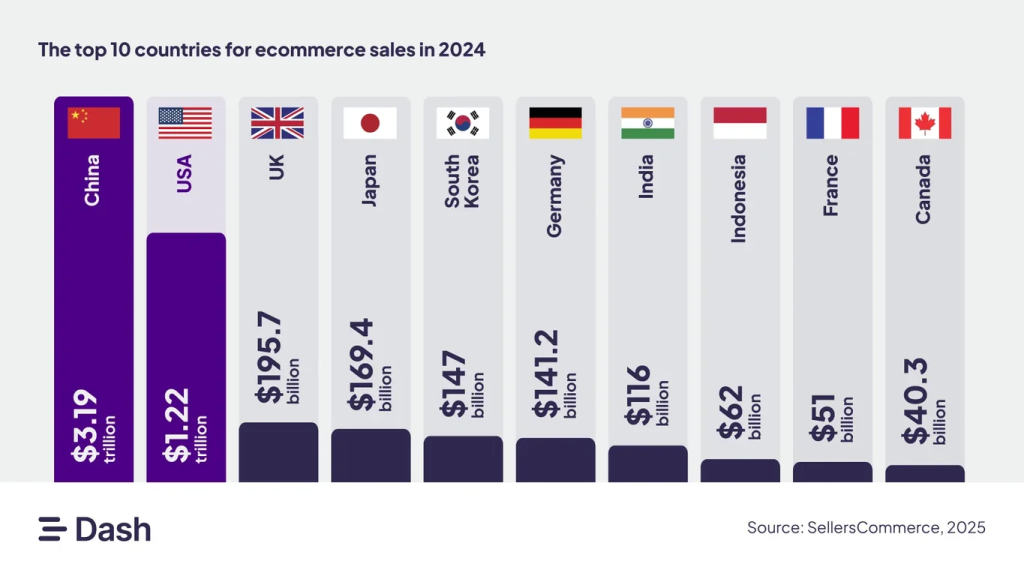
Source: Dash
According to SellersCommerce’s data published by Dash, China ($3.19 trillion), the USA ($1.22 trillion), UK ($195 billion), Japan ($169.4 billion), South Korea($147 billion) and Germany (141.2 billion) are responsible for the largest percentage of global e-commerce revenue. If brands decide to enter these markets, they will require specialised marketing, localisation, customer service, and logistics, which are typically outsourced to an external ecommerce agency while strategic oversight remains internal.
Key Roles That Become Non-Negotiable at the Growth Stage:
At this stage, businesses will begin to see an increasing number of customer support managers and operations managers as critical roles necessary to provide quality service to customers. In order to align the data between sales, support and marketing, CRM tools like HubSpot or Zoho are utilised in order to eliminate internal silos.
Where Internal Teams Work Best vs External E-commerce Agencies?
When it comes to how individuals and teams can work together to achieve ecommerce growth, the answer is easy: internal teams are best suited to handle brand knowledge and daily execution, whereas ecommerce agencies typically support performance marketing or search engine optimisation during the early stages of growth.
Agencies provide speed to market along with knowledge and experience, for instance, Nethority helped a certain saree brand scale its revenue by 100% in the growth stage.
Scaling-Stage E-commerce Team Structure (₹5Cr–₹25Cr Annual Revenue):
Building Functional Ownership Across Marketing, Operations, and CX:
At scale, it is critical that each function, including marketing, operations and customer experience, operates independently while still engaging in cross-functional collaboration. As a result, defined workflows and reporting structures become more important than individual talent.
The Role of Data Analysts in Scaling an E-commerce Store:
When it comes to scaling an ecommerce store, data analysts and business analysts play a key role; they are positioned strategically in the company to utilise the information from reports using analytics tools such as Google Analytics and Tableau to assist their teams in deciding where to focus resources on ROI measurement and maximisation.
Structural Challenges That Appear During Rapid Scale:
As businesses grow quickly, challenges will arise within their team structure. Common issues that may arise are a lack of communication and delays in gaining approvals. This can happen due to a lack of cross-functional collaboration, which can result in more time being spent on redundant tasks despite high budgets.
Enterprise-Level E-commerce Team Structure (₹25Cr+ Annual Revenue):
How Enterprise Ecommerce Team Structures Differ Fundamentally?
Enterprise e-commerce team structure typically consist of a product manager, a UX/UI designer, a supply chain manager, and an analytics manager. These roles typically have specific KPIs to measure performance and growth. The use of an enterprise-level ecommerce platform like Magento allows for the development of complex catalogues and operations across multiple markets.
Cross-Functional Collaboration Between Product, Tech, and Marketing:
At the enterprise level, a successful outcome relies on working together and having shared goals across product, marketing, and technology departments. When this occurs, the customer journey is seamless, and the messaging from each area is consistent.
Risks of Over-Hiring and Bureaucracy at Scale:
In large enterprises, the hierarchy of personnel creates inefficiencies and slows innovation for the company. The best enterprise e-commerce team structure maintain both flexibility and innovation, along with the accountability of all their team members.
Comparing In-House Teams vs E-commerce Agencies Across Revenue Stages:
When In-House Teams Are Better for an E-commerce Website?
In-house teams are the perfect solution for establishing a consistent brand identity, developing customer relationships, creating an exceptional customer experience, and optimising over the long term. No other model provides a level of familiarity with your customers or the internal systems of your brand that an in-house team can achieve.
When Ecommerce Agencies Deliver Higher ROI?
Ecommerce agencies are often most effective at performing specific, outcome-based tasks on the e-commerce level, e.g., expanding internationally or concentrating solely on executing short-term growth campaigns.
Hybrid Team Models That Work Best in Practice:
Hybrid team models are successful in application. They allow for team continuity and ownership while still allowing an ecommerce business to take advantage of the resources and experience offered by ecommerce agencies. They also give businesses the freedom to take risks and make changes quickly if needed.
Practical Team-Building Lessons from Real E-commerce Growth Journeys:
Common Hiring Mistakes E-commerce Founders Make:
Ecommerce founders frequently make the mistake of either hiring at the wrong time for senior roles or waiting too long to hire for operational support. Both situations lead to wasted or inefficient use of company resources.
How to Sequence Team Hiring Without Breaking Cash Flow?
Successful ecommerce marketing teams will reactively hire staff but plan proactively to add new roles only when the consistent increase in workload becomes disproportionate to the resources available to meet that demand.
Indicators That Your Current E-commerce Team Structure Is Holding Growth Back:
Missed deadlines, low customer satisfaction scores, and uncertainty about accountability indicate that the current structure of your team’s organisation or operation is not aligned to achieve the growth goals of your business.
Tools and Platforms That Shape Modern E-commerce Teams:
E-commerce Platforms and Their Influence on Team Skills:
The type of ecommerce platform you choose, be it Shopify, WooCommerce, or Magento, will affect your company’s hiring needs since a simple platform does not need as many technical specialists compared to a more complex stack that needs a more experienced team. However, you need to have a platform strategy in place for your ecommerce store to succeed.
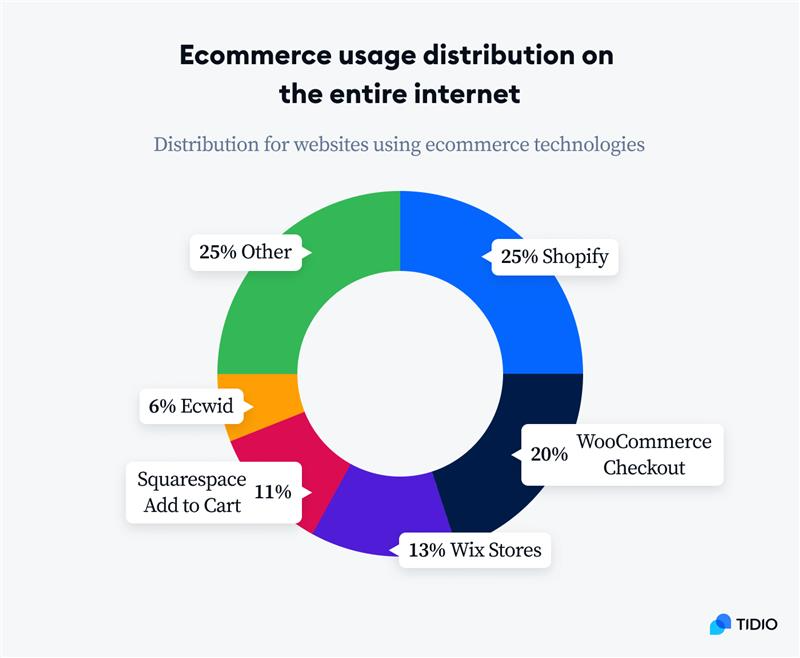
Source: Tidio
According to research by Tidio, for ecommerce platform usage, 25% ecommerce businesses use Shopify, 20% use WooCommerce, and others are at significantly lesser usage.
CRM, Marketing Automation, and Analytics in Daily Team Workflows:
Many ecommerce businesses use CRM tools such as Salesforce, HubSpot, or Zoho for efficient workflow optimisation. Analytics tools such as Google Analytics and Tableau help you understand performance. With tools such as Zendesk, Freshdesk, and others you can bring all your customer support together with your marketing and operations. Operations managers also utilise platforms such as Klaviyo and Mailchimp for marketing automation.
How Tool Complexity Changes with Revenue Growth?
As a company’s revenue grows the depth of the tools being used to support it grows as well. Therefore, the higher the depth, the more process structure that is required.
An early-stage business typically uses basic tools and relies heavily on manual processes. With increased order volumes, it becomes important to use automation, analytics and systems for the efficient management of the marketing process, inventory and customer experience.
At higher revenue phases, ecommerce platforms will only become effective once they are integrated into an established process with clearly defined roles; otherwise, they will result in additional expense and frustration for users rather than better performance.
How We’ve Seen High-Growth E-commerce Teams Evolve Over Time?
At Nethority, we work with ecommerce businesses at various stages of revenue and market maturity. It is observed that high-growth companies develop their organisational structure based on complexity rather than an increased number of employees.
At the early stage, the ecommerce teams are founder-led and execution oriented; they operate with a focus on speed rather than defining specific roles or responsibilities. As their revenue grows, these businesses typically begin to implement clearly defined areas of ownership in their functions: marketing, operations and customer experience, which allows them to focus on reducing their dependence upon individuals.
At the time of scaling their businesses, the need for data-driven analysis and the integration of cross-functional operational efficiency for enhanced speed and accuracy in making decisions becomes critical.
Although some enterprise-level organisations continue to grow successfully, their early alignment of product, marketing and operations before scaling serves to expose gaps in their overall structure.
Conclusion: Building A Sustainable E-Commerce Team Structure That Supports Growth
To build a sustainable business operations, it’s important to create your own e-commerce team structure rather than simply copying existing models by large companies. Organisations that are still in the early stages of growth often allow for greater levels of flexibility and speed in their operations. However, organisations that are growing need to establish a more formalised structure that defines the roles of marketing, operations, and customer experience departments.
As an organisation grows and its customer base expands, it is critical that the organisation puts in place infrastructure around data, process, and collaboration among all three functions. Creating the proper structure for e-commerce minimises risk and maximises opportunity. This builds teams that respond proactively to the changing nature of the ecommerce industry and grow in a healthy manner.
To sum it up, there is no one perfect e-commerce team structure. Each structure will grow with the revenue, complexity and ambition of the team. The teams that carefully scale build more resilience, provide a better customer experience and create long-term value, not just short-term growth.
FAQs:
E-commerce team structures combine functions of marketing, operations, technology and customer experience in order to ensure efficient management of acquisition, fulfilment, retention and growth.
The ecommerce team structure changes based on revenue growth; as revenues grow, the team’s roles change from generalists to specialists, with ownership moving up the line from marketing to operations to analytics to customer experience.
In the beginning stages, ecommerce businesses require a small team, around 2-4 members. As the company becomes more complex, the team will increase in size and add functional areas.
All core strategy, brand, and customer experience roles should be maintained internally, while execution of specialized tasks and short-term expertise are typically hired externally for scaling purposes.
Common mistakes ecommerce brands make when building their team include hiring too early or waiting too long to fill key positions, not having clear ownership of roles on the team, and increasing advertising spend at a faster rate than the team can grow in capability.