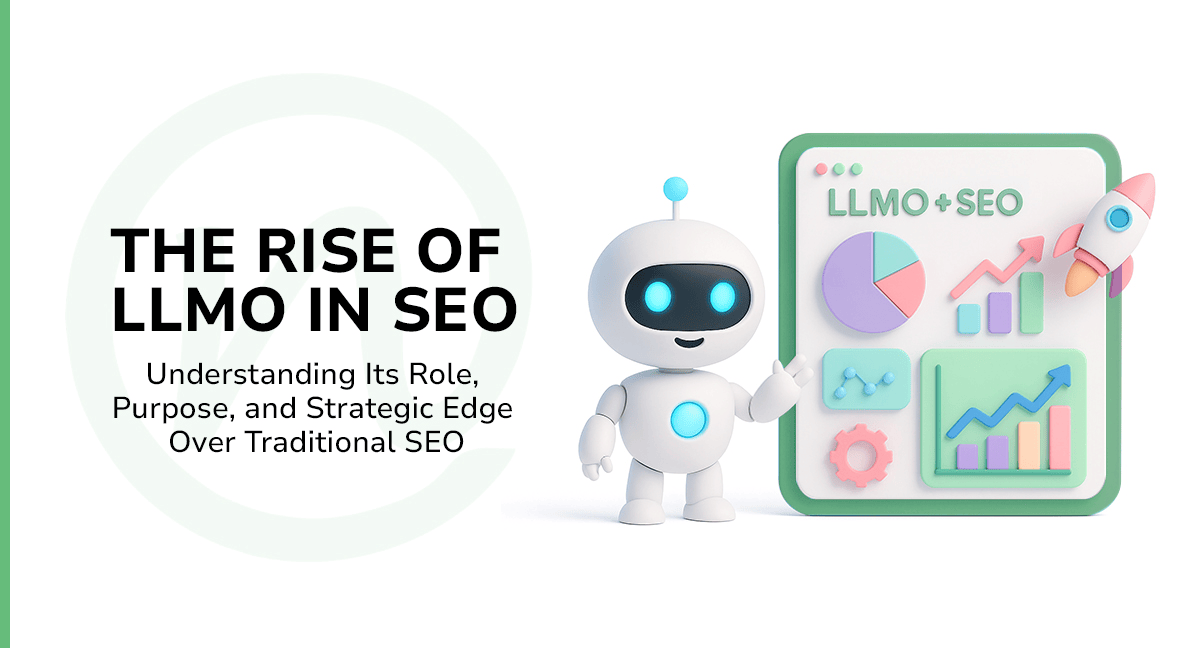
The Rise of LLMO in SEO: Understanding Its Role, Purpose, and Strategic Edge Over Traditional SEO
20th November 2025 / in SEO / by Ruturaj Kohok
- Reading time: 9 mins 12 Sec
Search is transitioning from link-based discovery to AI-generated responses. However, as AI will streamline more and more user decisions, LLMO will have much broader implications. It will bound how brands are understood, trusted, and recommended in conversational environments.
In this blog, we are now taking the next step of expanding further by examining its expanding role, its deeper purpose, and its unique strategic advantage over traditional SEO.
The Evolving Role of LLMO in an AI-Driven Search Landscape:
How has LLMO progressed since the first wave of LLM SEO?
LLMO has begun to extend traditional SEO, ultimately as a means of making content more readable for large language models. But it has become much more than just supporting LLM readability. LLMO represents an evolving practice which will shape how AI systems analyse and evaluate expertise across the web and how they assign authority and choose brand references without regard to traditional SERPs.
LLMO has shifted from a content adaptation discipline to a search-pattern strategy that aligns brand visibility with how AI actually reads and assesses the web. The evolution of this construct underscores that LLMO interprets not only how content is read, but how it is repeated, recommended, and reinforced by AI-generated answers.
LLMs as information gatekeepers and their impact on brand visibility:
As AI search ecosystems expand rapidly, LLMs have functioned as the new gatekeepers of information. While users would be sent to multiple links previously, AI models synthesise, reason, summarise, and produce the most trusted and contextualised information possible in seconds. Brands now find themselves in an entirely new competitive environment.
Visibility depends not only on ranking alone but also on how well a brand’s information fits within the reasoning of AI systems such as LLMs. Like humans when addressing a prompt, LLMs consider aspects such as clarity, depth, consistency, and credibility, with all of these being directly related to LLMO. Brands that leverage this new type of AI-gatekeeping behaviour will have much higher recall because they become the examples that domain knowledge is rooted in.
Why LLMO now influences both search engines and AI chatbots?
The true power of LLMO is that it plays a role in visibility for Google’s Search Generative Experience (SGE) as well as independent conversational LLMs like ChatGPT Search, Perplexity, Claude, and more. This opens entirely new search interfaces, where brands must remain discoverable not just through queries, but also through conversations. AI chatbots pull knowledge extraction differently compared to traditional search engines, placing more emphasis on contextual accuracy, entity signals, and topic coherence.
The Core Purpose of LLMO For Today’s Brands And Digital Ecosystems:
Enabling brands to be selected, cited, and repeated in AI responses:
The objective of LLMO in SEO is to improve the chance of a brand being chosen, cited, or referenced when AI generates a response. This is the basic difference between LLMO vs traditional SEO: Traditional search engine optimisation simply aims to win a ranking position. In contrast, LLMO aims to win a position in AI memory.
If AI uses your brand as an example, or continues to use your information to compile answers, it creates a powerful trust and recall cycle. The function of LLMO is to ensure your brand becomes the cognitive shortcut LLMs rely upon when creating answers across industries or platforms.
Creating content that AI systems can trust, understand, and reuse:
LLMs analyse information by clarity, factuality, contextual links, and strong entity signals. The function of LLMO is to shape content properly according to those evaluation patterns. High-quality content today is not simply about readability or keyword density, but the structure, depth, and evidence.
When an AI system trusts a source, it uses that source in answers, summaries, and comparisons. LLMO in SEO solidifies this trust by enabling brands to expose information in forms that both increase AI’s ability to correctly interpret and reproduce confidently.
Aligning brand knowledge with how LLMs interpret context and authority:
Every brand has information that adds to its digital identity, but not every brand formats that information in a way that AI systems will interpret correctly. The purpose of LLMO in SEO is to align a brand’s knowledge architecture with the way AI interprets relationships between concepts.
Through entity-focused content, consistent terminologies, and clear topical boundaries, LLMO ensures that brands fit cleanly into the conceptual frameworks that LLMs are building in the background. This creates greater trust because AI now begins to recognise the brand as a reputable source in its knowledge graph.
Supporting long-term organic growth in AI-driven search environments:
As traditional SERPs become increasingly embedded with AI summaries, rich answers, and conversational layers, brands that only go for keyword-based approaches will lose relevance long-term in the knowledge graph.
LLMO helps with long-term organic visibility by securing brands within the actual reasoning systems of AI, not simply within search indexes. Furthermore, it goes beyond creating long-term brand protection; it ensures that as search landscapes develop, brands are still embedded within the information models that support discovery.
The Strategic Edge of LLMO vs. Traditional SEO:
Why ranking on LLM answers matters more than ranking on SERPS?
The strategic advantage of LLMO in SEO is understanding that users do not need to browse through ten blue links to obtain answers. When AI synthesises answers, the brand referenced in the response has far more significance than the brands on a SERP.
LLMO gives the brand a place of importance when decisions are made quickly, as part of the AI answer itself, which drastically elevates its value over ranking.
How does LLMO generate higher recall through mentions, not clicks?
Moving from clicks to mentions and other ways users may achieve discoverability creates a shift in how brands engage in discoverability. LLMO is about being referenced inside summaries, comparisons, and recommendations that AI delivers.
AI references contribute to cognitive recall more than link-driven approaches. Repeated exposure and reference by an AI platform help a brand be considered a trusted example in its category.
The advantage of entity-driven authority over keyword-driven rankings:
While traditional SEO relies heavily on keywords, AI SEO emphasise entities: people, brands, concepts, and relationships. LLMO reveals entity strength by increasing clarity to AI systems about the characteristics, attributes, and expertise associated with an entity. This gives brands a strategic advantage because stronger entities will be prioritised over keyword-optimised content in LLM-driven searches.
Why AI search rewards contextual expertise instead of content volume?
Unlike traditional SEO frameworks that valued sheer quantity, LLMOs value depth, context, and accuracy. Along with depth, it also allows brands to present fewer sections of content but go deep enough to show expertise in the subject. This not only builds trust but also allows AI systems to develop more accurate representations of the brand.
Implementing An Advanced LLMO Strategy For Sustainable Visibility:
Building knowledge layers around your brand for AI-retrieval:
Establishing a robust LLMO strategy demands that the information be structured in a way that allows AI to retrieve, link, and apply it correctly. The essence of this demand is strengthening long-form content, such as FAQs, definitions, case studies, and explanations, that strengthens the brand’s internal knowledge graph.
Structuring content for interpretability, reasoning, and accuracy:
For LLMO in SEO, content should be constructed in a way that supports multi-step reasoning. This means clear presentations, transparent claims, linked concepts, and approachable language that’s understandable by AI without ambiguity, as structured content improves AI comprehension.
Measuring your brand’s presence across AI answer platforms:
As LLM-based search is increasingly used, you will want tools that monitor AI mention frequency, citation use, and conversational visibility to measure your brand presence. These metrics will shed light on how often and how correctly AI systems are referencing you to help alter your LLMO strategy if needed
Why does human-centric writing still matter in LLMO in SEO?
An effective LLMO strategy balances LLM clarity with human value. Humans create nuance, storytelling, and emotional depth, all of which AI systems perceive as signs of authentic expertise. Readability for both LLMs and humans is critical to building visibility that lasts.
Final Thoughts: How LLMO Positions Brands At The Centre of AI-Visibility
The emergence of LLMO signifies a change in how brands are perceived, assessed, and suggested by AI platforms. By forming content around clarity, authority, and relevance, LLM SEO places brands at the very heart of contemporary AI-based discovery. This new form of search favours those optimising for AI’s emerging intelligence over traditional mechanisms of ranking. LLMO is no longer an update; you must incorporate it into traditional SEO, as it will be the strategic backbone of future brand visibility.
FAQs:
LLMO is important because AI platforms increasingly determine whether your brand appears in the answer. When you optimise for LLMs, you create more visibility, earn more trust, and find opportunities for brand mentions consistently across conversational search contexts.
To optimise for LLMs, you should create content that is clear, factual, well-structured, and authoritative, with strong entity signals, contextual depth, and consistent terminologies. You want the AI to easily interpret, verify, connect, and repurpose your information in its responses.
LLMO is useful for ecommerce and D2C brands in appearing in AI-generated recommendations, buying guides, comparisons, and product queries. It builds category authority, improves recall, and increases visibility on AI platforms when customers search for an instant answer.
SEO has traditionally revolved around rankings and keywords, while LLM SEO focuses on contextual clarity, entity relationships, and appearing in AI-generated answers. LLMO optimises content for how AI thinks, connects dots, and makes recommendations.
Generally, brands can expect to see early gains within 2 to 3 months, depending on content depth, authority and the strength of the entity as well. However, to see long-term results that drive conversions, it may take 6 months to a year.